
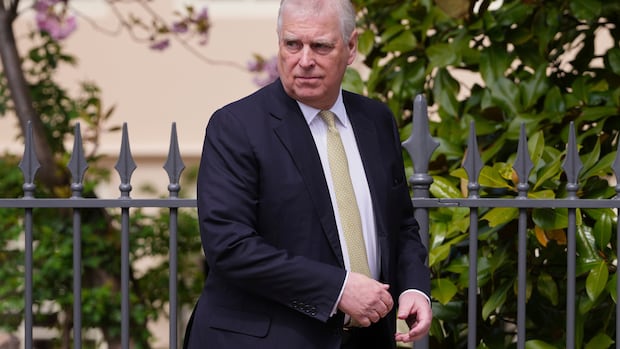
On Friday, Prime Minister Mark Carney stated that the disgraced former prince Andrew Mountbatten-Windsor should be excluded from the line of succession due to his “deplorable” conduct.
While addressing the press in Tokyo at the conclusion of his 10-day tour of the Indo-Pacific region, Carney emphasized the need to initiate the removal process.
This action would involve collaboration with other Commonwealth realms that recognize King Charles and his successors as their sovereign, to prevent any unintentional ascension of Mountbatten-Windsor to the throne.
“I firmly believe that his actions are reprehensible and have led to his loss of royal titles. His removal from the line of succession is warranted—indeed, it is necessary. Even if he is far down the line, the principle remains significant,” Carney remarked.
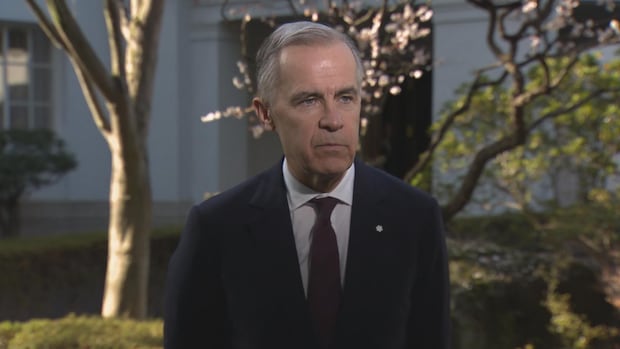
Prime Minister Mark Carney asserts that the “deplorable” actions of Andrew Mountbatten-Windsor “necessitate” his removal from the royal line of succession.
These remarks followed Carney’s meeting with Australian Prime Minister Anthony Albanese, who was the first leader of a Commonwealth realm to advocate for the complicated process of removing Mountbatten-Windsor from the list of potential successors to Charles after his arrest.
“These are serious allegations that Australians regard with utmost seriousness,” Albanese expressed in a letter to UK Prime Minister Kier Starmer last month, who is reportedly contemplating legislative modifications.
“My administration would support any initiative to remove him from the royal succession line. I concur with His Majesty that the law must be fully applied, and a comprehensive, fair investigation is imperative,” Albanese stated. He referred to the King’s declaration and noted his “deepest concern” following the arrest of the monarch’s brother for misconduct in public office.
Following the revelation of Mountbatten-Windsor’s associations with serial sexual abuser Jeffrey Epstein—later confirmed by a trove of documents from the U.S. FBI that indicated he was seeking “inappropriate friends”—he was stripped of his titles, which included Prince, Duke of York, Earl of Inverness, Baron Killyleagh, and His Royal Highness.
However, this action alone does not alter existing British and Commonwealth laws regarding who is eligible to ascend to the throne.
Currently, Prince William is first in line, followed by his son, Prince George.
Mountbatten-Windsor ranks eighth in the order of succession. This means that all individuals ahead of him must either pass away, abdicate, or be removed to create an opportunity for him to claim the title—and all realms must act collectively to amend that situation.
Carney emphasized the urgency of this process, stating, “There is a procedure to outline that process,” acknowledging the complications that may arise from such changes.
The last alteration to the line of succession occurred in 2013, with the implementation of the U.K.’s Succession to the Crown Act, which introduced significant reforms in the way monarchs ascend to the throne.
Following this, Canada enacted its own legislation, the Succession to the Throne Act, which aligned with the changes in British law—a constitutional requirement given that the Canadian crown is separate from that of the U.K. and other realms, despite being the same person across all territories.
This legislative update ended the long-standing rule that prevented anyone marrying a Roman Catholic from becoming monarch, but it maintained the restriction on individuals of that faith from ascending to the throne, as the British sovereign acts as the supreme governor of the Church of England.
However, the law is predominantly recognized for eliminating the male preference in the line of succession, thereby placing male and female heirs on equal footing when the throne is passed down through generations.
For this amendment to take effect, agreement from each of the Commonwealth realms was essential.
At the time of these changes, there were 16 realms, including the U.K.
Six realms enacted corresponding laws to synchronize their succession regulations: Australia, Barbados, Canada, New Zealand, St. Kitts and Nevis, and St. Vincent and the Grenadines. Nine additional realms opted out of legislative changes, as their local laws already acknowledged the incoming U.K. monarch as their next head of state.
Since then, Barbados has transitioned to a republic, leaving 15 realms, including the U.K., in the Commonwealth.
The intricate details of the last revision were finalized during the 2011 Commonwealth Heads of Government Meeting attended by all affected nations.
This biennial summit, which will be led by King Charles as the head of the Commonwealth, is anticipated to take place later this year in Antigua and Barbuda.
Tag: rewrite-pending