
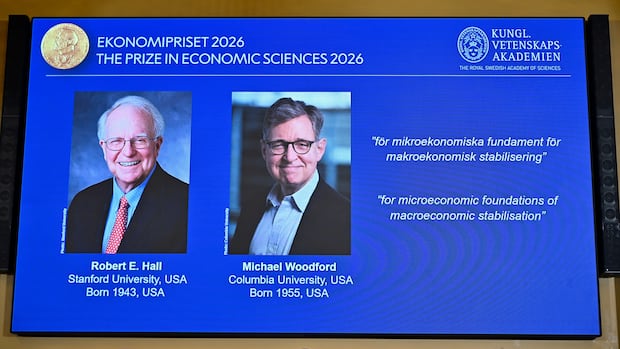
American economists Robert E. Hall and Michael Woodford, both born in the U.S., were awarded the Nobel memorial prize in economics for their research on models that have assisted governments and central banks in handling economic shocks. The Royal Swedish Academy of Sciences disclosed the laureates’ names in Stockholm, praising their contributions to policymakers in managing economic fluctuations.
Hall, associated with Stanford University in California, and Woodford, affiliated with Columbia University in New York, were commended for their efforts to stabilize the economy’s highs and lows. Woodford expressed his surprise and honor during a phone call with the committee from New York.
Their work has laid a stable theoretical groundwork for the models currently utilized by central banks and governments worldwide, stated John Hassler, the chair of the Committee for the Prize in Economic Sciences. These models aid in addressing economic shocks like energy crises or sudden shifts in consumer spending patterns.
Over the years, governments followed the Keynesian approach of stimulating the economy by reducing taxes and increasing government spending to promote consumer and business investments, based on theories by economist John Maynard Keynes. However, the oversimplified formula faced challenges during the stagflation period of the 1970s, characterized by high inflation and unemployment rates worldwide.
Hall and Woodford devised an enhanced model that considers the decision-making processes of consumers and businesses in investing and spending. This new foundation for stabilization policy has revolutionized economic management practices, as highlighted by Hassler. Last year, researchers delved into business innovation, with Canadian economist Peter Howitt among the honorees, explaining how new products drive economic growth while affecting existing companies.
The Nobel memorial prize in economics, also known as the Bank of Sweden Prize in Economic Sciences in Memory of Alfred Nobel, was established in 1968 to honor Alfred Nobel, the Swedish inventor of dynamite and founder of the Nobel Prizes. While technically not a Nobel Prize, it is awarded alongside the others annually on Dec. 10, Nobel’s death anniversary in 1896. Nobel honours across various categories were announced earlier, with the economics prize carrying a monetary award of 12 million Swedish kronor (approximately $1.7 million CAD) for individuals, small groups, or organizations.