
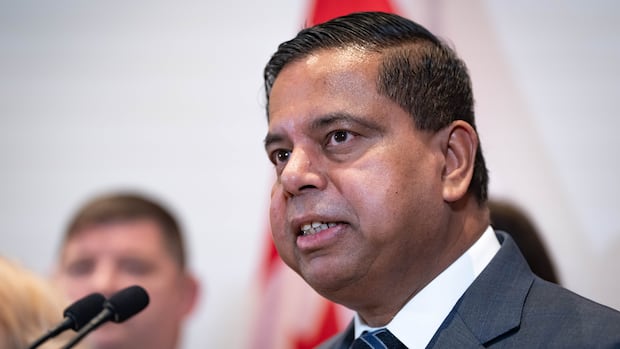
Public Safety Minister Gary Anandasangaree informed a parliamentary committee that individuals breaching the new regulations against foreign interference in Canada may face heightened penalties. Anandasangaree disclosed plans to revise the proposed rules to raise the minimum penalty for offenders beyond the initial $50 fine. He mentioned that the new minimum threshold is yet to be determined, but emphasized that the range will extend from $50 as the minimum to $1,000,000 as the maximum.
Anandasangaree clarified to reporters that the fines for violations will be determined by the foreign influence transparency commissioner, taking into account factors such as intentional violation of rules and any prior infractions by the individual. He highlighted that the government is considering various changes to the regulations based on feedback from the public and opposition MPs to safeguard Canada and its elections from external interference.
The Minister refrained from disclosing additional proposed changes, stating that the government aims to secure cabinet approval within a few weeks and subsequently publish the modifications in the Canada Gazette. Typically, there is a delay of several days between the approval of an order-in-council by the cabinet and its publication for enforcement.
Anandasangaree’s remarks follow Parliament’s decision a year and a half ago to establish a system for monitoring potential interference by foreign agents. The legislation mandates the appointment of a foreign influence transparency commissioner and the establishment of a registry listing individuals acting as agents on behalf of foreign governments in Canada.
In a final report in January 2025, an inquiry led by Justice Marie-Josée Hogue highlighted transnational repression in Canada as a significant concern, identifying the People’s Republic of China as the primary perpetrator of foreign interference targeting Canadian democratic institutions.
The Minister announced the government’s intention to appoint Anton Boegman, former B.C. chief electoral officer, as Canada’s inaugural foreign interference transparency commissioner. Anandasangaree aims to have Boegman endorsed by the House of Commons and the Senate soon for the commissioner’s office and the foreign agent registry to be operational by early spring, although he declined to provide a specific launch date.
Anandasangaree emphasized that the new foreign interference regulations will apply universally to all countries, including the United States, without restrictions based on nationality. However, he refrained from commenting on recent incidents involving meetings between U.S. State Department officials and supporters of Alberta’s separatist movement, stating he would not speculate on such matters.
During the committee session, opposition MPs, including Conservative Michael Cooper, pressed Anandasangaree on the delayed appointment of a commissioner, the drafting of regulations, and the implementation of the registry since the legislation’s adoption. Cooper criticized the $50 minimum fine for violations as inadequate, advocating for a substantial increase in the penalty amount. He also expressed the urgency for the system to be operational after encountering a two-year delay.