
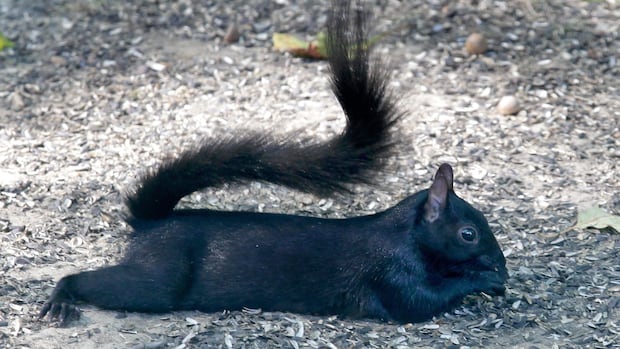
Francis Quang-Hai Dinh explored Montreal’s parks on his bicycle during his first summer at McGill University, studying squirrels. He meticulously observed and documented over 800 grey and black squirrels across nearly 200 green spaces from Mirabel to Saint-Bruno. What began as a simple undergraduate task evolved into a personal project to understand how the city’s design and waterways influence evolution subtly.
Dinh, now an integrative biology student at the University of Illinois Urbana-Champaign, became the sole researcher known to manually survey squirrels park-by-park across the region due to limited transportation options in suburban areas.
His research revealed that black squirrels are more prevalent in northern regions. While about 12% of Montreal’s squirrels are black on average, this percentage increases as one moves further north. For instance, just north of Laval, up to 40% of squirrels were black, while on the island of Laval, around 20% were black, and on the island of Montreal, approximately 15%. In contrast, the south shore of Montreal had only two to three percent black squirrels. The study attributed this distribution to temperature variations, as black fur absorbs heat more efficiently in cooler climates.
The study also highlighted the impact of forest cover on squirrel coat coloration. Areas with denser tree canopies provide a darker backdrop, allowing black squirrels to blend in better for camouflage.
Allison Roth, the study’s senior author and an assistant professor at the University of Missouri, emphasized that the research focuses on using squirrels as a model to examine how urban settings drive evolutionary adaptations.
Montreal’s unique geography, segmented by the St. Lawrence River and its tributaries, creates diverse environments that lead to genetic and physical changes in animal populations. Roth noted that these fine-scale variations in urban landscapes play a crucial role in shaping wildlife adaptations.
The study, “Fine-scale spatial variation in eastern grey squirrel melanism across a complex urban landscape,” breaks down evolutionary changes in wildlife on a neighborhood level, challenging the notion that human development alone drives these transformations. Urban sprawl alters local temperatures and reduces tree cover, while natural barriers like riverways influence genetic adaptations.
Ultimately, the research underscores the importance of considering local environmental factors in understanding evolutionary changes in wildlife. Dinh reflected on how his perspective on wildlife has shifted, emphasizing the coexistence of nature and urban environments despite human alterations.