
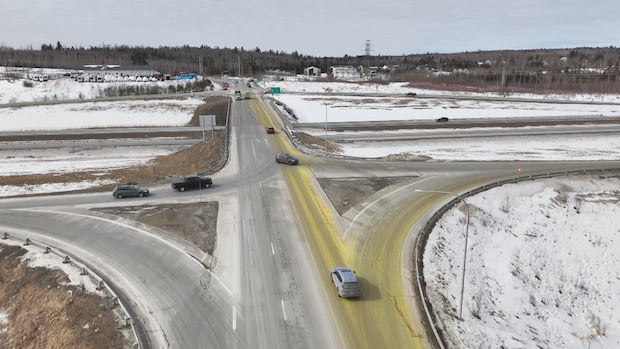
The New Brunswick government took over a day to inform the public about a chemical spill on a 14-kilometer stretch of highway in Fredericton that contained a cancer-causing compound, according to documents obtained by CBC News. The documents, acquired through a right to information request, revealed that Department of Environment officials were aware of the presence of hexavalent chromium in the spill on and around the Vanier Highway by around 1 p.m. on March 6. However, it wasn’t until approximately 4 p.m. the following day that the province publicly disclosed the high levels of the carcinogenic compound in the bright yellow substance.
The Government of New Brunswick stated in an update on its Facebook page on March 7 that a brief or limited exposure to hexavalent chromium does not increase the risk of cancer. The documents, primarily comprising emails and reports exchanged among provincial government personnel, provided an inside look at the handling of the chemical spill that led to road closures and raised concerns about the health and safety of individuals who passed through the affected area before cleanup operations commenced. Approximately 900 liters of the yellow substance stained sections of Vanier Industrial Drive, the Vanier Highway, and the Trans-Canada Highway after leaking from a damaged plastic tote being transported on a truck.
XL Plating and Machining was identified by the province as the responsible party for the spill, although attempts by CBC News to contact the company for a response were unsuccessful. Emails indicated that the Department of Environment was alerted to the spill by a City of Fredericton employee on the morning of March 5. Samples were collected for testing later that day, with results confirming the presence of hexavalent chromium by the following day, although this detail was not initially disclosed to the media.
The chemical substance involved was traced back to a waste product from chrome stripping used by XL Plating and Machining, a chromium electroplating business specializing in hard chrome resurfacing of machine components. The spill stemmed from the use of sodium carbonate and sodium hydroxide in stripping chrome plating off machine parts. The spilled material, described as a spent chrome stripping solution, was found to contain hexavalent chromium through testing. An email exchange between government and WorkSafeNB staff shed light on the nature of the spilled substance and the processes involved at XL Plating and Machining.
Ongoing testing to assess potential contamination levels from the spill revealed elevated levels of hexavalent chromium in samples taken from the affected areas along the Vanier Highway. The Department of Environment reported that no contamination of drinking water sources had been detected, although testing would continue. Environmental consultants are scheduled to drill groundwater monitoring wells in the spill-affected locations to further assess the situation.