
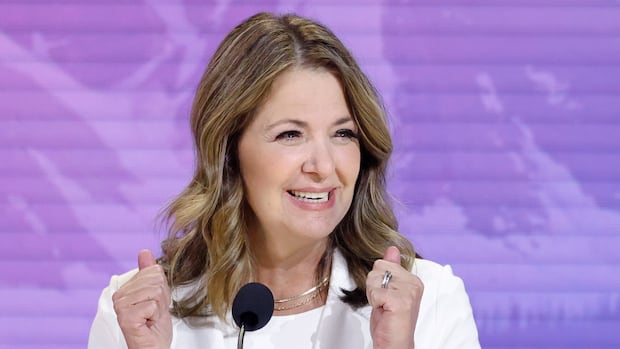
Alberta Premier Danielle Smith showcased her popularity and conservative stance to attendees at the Conservative Party convention, avoiding direct mention of the separatist issue that has been prominent in recent news. Smith’s warm reception at the event in Calgary highlighted her influence within conservative circles and the convention’s setting in a conservative stronghold.
Addressing the crowd to applause, Smith expressed pleasure in welcoming Conservatives from across the country to Calgary, emphasizing the city as the heart of conservatism in Canada. While delivering parts of her speech in French, she touched on familiar topics in Alberta politics, commending delegates for supporting Conservative Leader Pierre Poilievre with an 87.4% mandate.
Smith criticized the previous Liberal government, particularly targeting former Prime Minister Justin Trudeau and ex-Environment Minister Steven Guilbeault, for their impact on Alberta’s economy and interference in provincial affairs. Without naming Prime Minister Mark Carney directly, she alluded to his comments about pipelines, stressing the Conservative support for pipeline development.
Despite historical tensions between Alberta and Ottawa, Smith highlighted a recent collaboration agreement with the federal government on a new bitumen pipeline as a sign of potential improvement in their relationship. However, some United Conservative Party separatists at the convention expressed skepticism, emphasizing the need for tangible progress to support Alberta’s interests.
In her speech, Smith also advocated for stricter bail and sentencing laws, criticized Ottawa’s firearms policy, and called for reduced immigration levels. Delegates praised her speech, noting her appeal to Conservative Party members, particularly the younger generation. While Smith covered various key issues in Alberta politics, she avoided delving into the separatist movement developments that have garnered national attention.
Smith has consistently supported a strong and united Alberta within Canada, rejecting separatism while acknowledging the concerns of Albertans who have lost faith in the federal system. In contrast, Poilievre addressed the resurgence of separatist movements in his speech, urging understanding rather than condemnation for those leaning towards separatism.
A recent survey indicated a divided sentiment in Alberta, with a significant portion of Conservative Party voters open to the idea of Alberta leaving Canada. This polarization poses a challenge for Smith as she navigates the delicate balance of addressing separatist sentiments and advocating for a fairer relationship with the federal government.
Overall, Smith’s presence and message at the Conservative convention resonated with attendees, showcasing her leadership and alignment with conservative values, while also hinting at the complex political landscape in Alberta.