
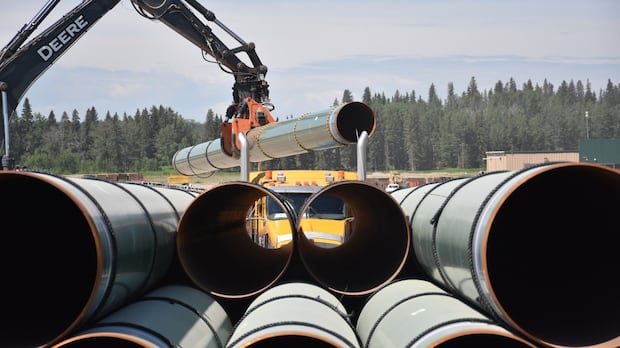
Alberta has approved a significant borrowing capacity of almost $1 billion for its commercial oil and gas agency to explore market investments. This move is believed to potentially attract private investors interested in funding a pipeline project to the British Columbia coast, as per an industry expert.
The authorization serves as a line of credit for Alberta’s Bitumen Royalty-In-Kind (BRIK) program, which was introduced in March. It empowers the Alberta Petroleum Marketing Commission (APMC) to borrow up to $900 million for various “hydrocarbon marketing activities,” including purchasing shares, providing loans, forming joint ventures, guaranteeing obligations, and creating subsidiary corporations.
Richard Masson, a former CEO of the commission and current executive fellow at the University of Calgary’s School of Public Policy, noted that these activities align closely with positioning APMC as a potential proponent for a northwest coast pipeline.
However, a spokesperson from the province’s energy and minerals department clarified that the line of credit is not specifically linked to any existing or future pipeline projects. It is meant to be a financial resource available if necessary, rather than funds already allocated or lent.
The construction of a privately-funded pipeline to the B.C. coast was a significant component of a landmark energy agreement between Alberta and the federal government. Despite this, no company has yet committed to spearheading the project, attributing challenges such as the B.C. oil tanker ban and opposition from Coastal First Nations as deterrents for potential investors.
Masson highlighted the inherent risks associated with pipeline ventures, citing the failed $600 million Northern Gateway pipeline by Enbridge as a cautionary tale. He emphasized that APMC’s borrowing authority could potentially mitigate financial risks for private investors, making the project more appealing.
The borrowing authorization enables the province’s finance minister to raise funds through government securities and transfer them to APMC. This mechanism could provide financial support to private investors while minimizing their exposure to risks.
Robert Johnston, director of energy and natural resources policy at the University of Calgary’s School of Public Policy, emphasized that the line of credit is primarily focused on enhancing marketing capabilities in the U.S. and Asia through existing infrastructure, rather than directly influencing a pipeline project.
The Bitumen Royalty-In-Kind (BRIK) program represents a shift from a cash royalty system to collecting royalties in barrels of bitumen, allowing the government to streamline its market engagements. This approach could facilitate negotiations with Asian refineries, particularly those with government affiliations, as they often prefer government-to-government transactions.
The revival of a program similar to BRIK was previously considered during Masson’s tenure at APMC, but was ultimately deemed overly complex. However, the current resurgence of interest in the program may be driven by the province’s efforts to bolster oil volumes in existing pipelines to support expansion plans.
Despite ongoing pipeline expansions by Enbridge and Trans Mountain, Masson noted that increasing capacity does not necessitate changes to how bitumen royalties are collected. The province can achieve this by procuring oil and transporting it through existing pipeline infrastructure.