
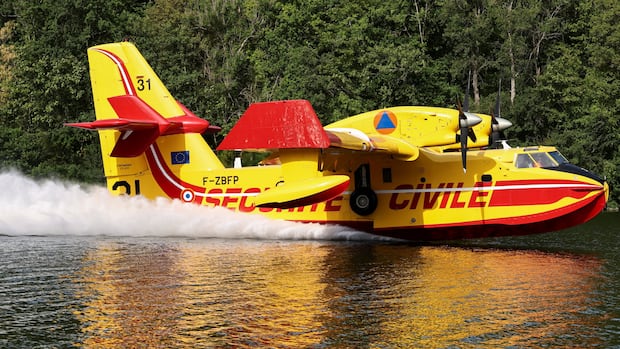
As wildfires ravage Canada, the United States, and Europe, there is mounting pressure on the manufacturer of the Canadair “Super Scooper” water bombers to ramp up production, and on the federal government to place a large order for the aircraft. De Havilland, based in Calgary, is resuming production of the Canadair following its acquisition of the water bomber program. These airplanes were previously manufactured by Bombardier until 2015.
The renowned Canadair aircraft are meticulously handcrafted in Calgary, with components sourced from across Canada. The announcement of the revived production line in 2022 is yielding results, with the first two aircraft expected to be completed and delivered by early 2028. Demand for these aircraft is high among Canadian premiers and European leaders due to current shortages and aging fleets.
Originally designed in the 1960s, the Canadair amphibious firefighting plane was purpose-built for combating large wildfires in the Canadian wilderness. Its unique capabilities allow it to maneuver through narrow canyons at low altitudes and swiftly collect thousands of liters of water from lakes, rivers, and oceans.
In response to criticism from opposition politicians in France and Spain about insufficient operational Canadairs, De Havilland is feeling the political pressure. With ongoing shortages of water bombers, there is a growing urgency for new aircraft to combat extreme weather conditions and wildfires.
De Havilland is contemplating the construction of a second production line to meet the soaring demand for Canadair aircraft. Alberta Premier Danielle Smith is collaborating with provincial counterparts and the federal government to facilitate a substantial order from Ottawa, which could pave the way for the establishment of a second production line.
The need for additional production lines for Canadairs is underscored by aviation expert John Gradek from McGill University, who warns of potential competition from foreign companies if the demand is not met. The threat of foreign companies developing rival firefighting aircraft poses a risk to Canadian manufacturing jobs.
A Senate report released in June recommends the creation of a national fleet of modern firefighting aircraft to address the escalating wildfire crisis in Canada. While aircraft play a vital role in battling wildfires by aiding ground crews and containing the spread, they are just one component of a comprehensive firefighting strategy.
The federal government is committed to enhancing national capacity to respond to intensifying wildfire seasons, emphasizing collaboration with provincial and territorial entities to effectively combat the growing impact of wildfires.