
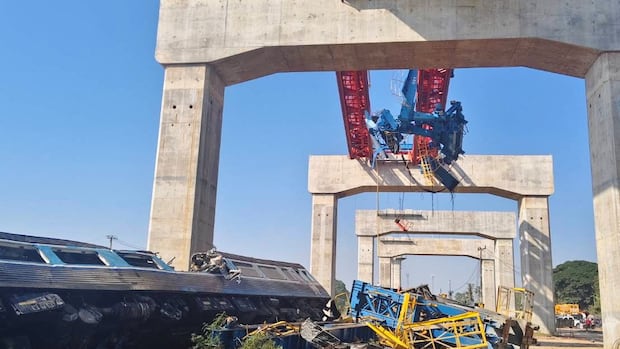
A tragic incident unfolded in northeastern Thailand as a construction crane fell onto a moving passenger train, leading to a derailment that resulted in the loss of at least 32 lives and left numerous individuals injured. The calamity occurred on a section of an extensive high-speed rail project intended to eventually link China with various parts of Southeast Asia.
The mishap transpired while the train was en route from Bangkok to Ubon Ratchathani province, with the crane collapsing as it was being utilized in the construction of an elevated railway segment, as reported by the public relations office for Nakhon Ratchasima province, the location of the accident. Images depicted in Thai media displayed billows of smoke emanating from the site, with construction equipment dangling amidst concrete support pillars.
Rescue operations showcased emergency personnel on overturned train carriages, some exhibiting substantial damage, while sections of the fallen crane littered the railway track. Paramedics were seen attending to wounded passengers, underscoring the gravity of the situation.
Following the incident, Thai media disclosed that the train consisted of three carriages, with the latter two bearing the brunt of the damage. Transport Minister Piphat Ratchakitprakan confirmed that 195 individuals were aboard the train and announced an official inquiry.
The collapsed elevated section forms part of the Thai-Chinese high-speed railway initiative connecting Bangkok with Nong Khai province on the Laos border. This project, with an estimated investment outlay of approximately $23 billion Cdn, aligns with efforts to establish connectivity between China and Southeast Asia under the Belt and Road Initiative spearheaded by Beijing.
Notably, in August 2024, another mishap occurred along the same route in Nakhon Ratchasima when a railway tunnel collapse claimed the lives of three workers. The incident was attributed, in part, to days of intense rainfall affecting the region.