
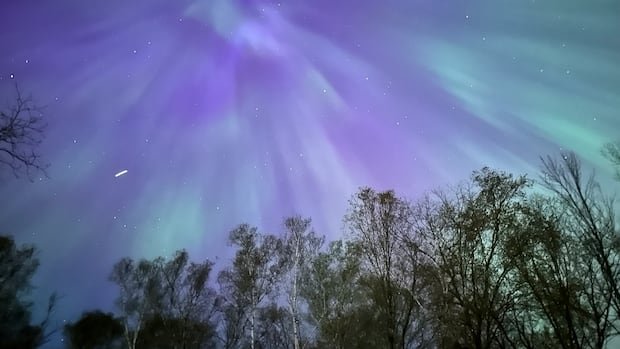
On Monday night, the northern lights are expected to be visible due to a powerful X 1.9 solar flare and subsequent coronal mass ejection (CME) released by the sun. The extended duration of this flare sets it apart from typical flares of similar magnitude, making it more potent. CMEs are solar explosions that release particles into space, and when these particles interact with the Earth’s magnetic field, they can create the beautiful aurora borealis in the northern hemisphere and aurora australis in the southern hemisphere.
The CME from the recent solar activity is predicted to reach Earth between late January 19 and early January 20. This event is forecasted to cause a severe G4 geomagnetic storm, which can lead to disruptions in Earth’s magnetosphere. In comparison, the geomagnetic storms in May 2024 and October 2024, which produced stunning light displays even in the Caribbean, were classified as G5 storms.
While the aurora borealis is typically seen in northern regions, under favorable conditions – such as Earth being in the CME’s path – they can be visible farther south. For the lights to be visible further south, the auroral hole through which the CME particles travel must shift southward. The timing of the storm is crucial, as it needs to coincide with nighttime for optimal viewing.
Although this time of year is not ideal for viewing the northern lights due to increased cloud cover, individuals can maximize their chances by heading to dark, cloud-free locations. Given the severity of the forecast, it may not be necessary to face north to witness the spectacle, though it can enhance the experience if the storm intensity is moderate.
For those interested in tracking the visibility of the aurora borealis in their area, apps like Aurora Alerts and Aurora Forecast can be useful tools.