
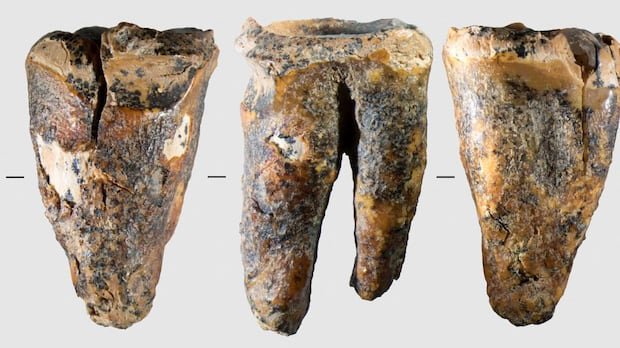
About 59,000 years ago, a Neanderthal residing in the Siberian mountains experienced severe tooth pain and took action to alleviate it. Recent findings suggest that a lower molar discovered in a cave at the Altai Mountains exhibited signs of dental treatment – a sizable hole that seemed to have been manually drilled with a stone tool to extract decay.
This discovery, detailed in a study published in the journal PLOS One, marks the earliest-known instance of invasive dental surgery, predating the earliest evidence of homo sapiens addressing cavities. It contributes to the mounting evidence indicating that the extinct archaic human species possessed a higher level of sophistication than commonly acknowledged.
Anthropologist John Olsen, a co-author of the study, deliberated on the scenario of a Neanderthal seeking dental assistance when faced with an infected tooth. He proposed two potential scenarios: either the individual sought external help due to unbearable pain or attempted self-treatment by drilling the tooth with a stone tool. Olsen dismissed the latter as improbable, emphasizing the social nature of Neanderthals.
While the existence of Neanderthal dentists is doubtful, the meticulousness of the procedure hints at a skilled individual performing the intervention. The tooth, belonging to an adult Neanderthal of unidentified gender, was excavated in Chagyrskaya Cave, a significant site for Neanderthal fossils in Russia. Analysis revealed intentional modifications on the tooth, distinct from accidental damage or natural wear.
To validate their findings, researchers conducted experiments on modern human teeth, successfully replicating the hole’s characteristics by drilling with a similar stone tool found at Chagyrskaya Cave. This discovery challenges the conventional belief that intricate behaviors were exclusive to modern humans, showcasing Neanderthals’ advanced cognitive abilities and medical strategies.
Neanderthals, who coexisted with Homo sapiens until their extinction approximately 40,000 years ago, have often been misrepresented in popular culture as unintelligent. However, recent studies have debunked these misconceptions, highlighting various Neanderthal accomplishments such as art creation, tool crafting, hunting, ornamental jewelry-making, burial rituals, and medical care practices.
The significance of the Neanderthal dental surgery lies not only in their potential medical capabilities but also in their communication skills. The procedure, conducted without modern pain relief, underscores the necessity for effective communication to convey the long-term benefits of enduring short-term discomfort. This challenges the stereotypical view of Neanderthals as primitive beings and underscores their complexity as a species.