
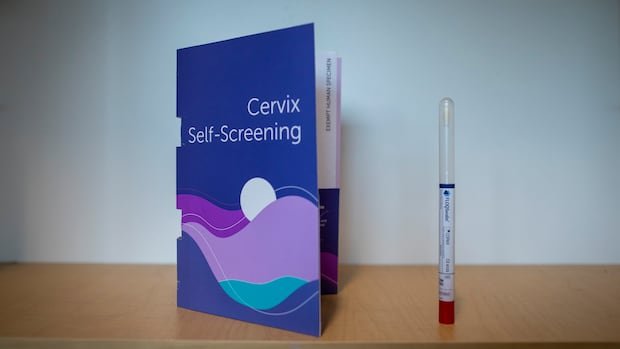
U.S. health authorities are supporting a more convenient approach to cervical cancer prevention, which is not widely available in Canada. The Health Resources and Services Administration has released new guidelines to eventually enable women and individuals assigned female at birth to have easier access to self-testing kits for the human papillomavirus (HPV), a sexually transmitted infection that can lead to cervical cancer. This marks a shift towards utilizing HPV tests over the traditional Pap smear, which can be conducted by either a healthcare provider or self-administered.
Early detection of cervical cancer through regular screening leads to a 90% five-year survival rate. While many Canadian regions now recommend HPV screening instead of the Pap test for cervical cancer prevention, self-administered tests are not readily accessible outside of British Columbia. Here’s what you should know about HPV self-testing and its availability.
The at-home HPV tests function similarly to the rapid COVID-19 tests conducted at home. A swab is utilized to gather a specimen from inside the vagina, without the need for a speculum, unlike a Pap smear or clinician-administered HPV test. The self-testing swab does not require direct contact with the cervix, reducing potential discomfort experienced during a Pap smear.
There is no immediate result with HPV screening; the sample must be sent to a lab for testing. Self-collection not only allows for private testing at a convenient time but also encourages more individuals to undergo HPV screening, especially those who have never been tested or do not test frequently, as per the Canadian Partnership Against Cancer.
In terms of accuracy, Pap smears screen for abnormal or precancerous cervical cells with less than a 60% accuracy rate, while HPV testing detects the virus’s DNA with an accuracy exceeding 90%, as indicated by a 2022 study. Nearly all cervical cancer cases are caused by HPV, with specific strains responsible for over 70% of cases globally.
While a positive HPV test does not guarantee cancer development, further examination may be necessary, including a Pap smear. However, there are rare instances where HPV testing may not detect certain cervical cancers. Health Canada suggests Pap tests every three years and HPV screening every five years.
In the U.S., the new guidelines allow women and individuals assigned female at birth aged 30 to 65, with an average risk of cervical cancer, to opt for self-testing. Starting January 1, 2027, most private insurance companies will cover the test costs. Individuals can still choose a clinician-administered HPV test or Pap smear.
The American Cancer Society estimates approximately 13,000 new cervical cancer cases annually in the U.S., resulting in around 4,300 deaths each year. HPV infections are common, with 75% of sexually active individuals experiencing at least one HPV infection in their lifetime, often asymptomatic. Vaccination against carcinogenic and non-cancer-causing HPV strains has contributed to a decline in cases, although recent data indicates a plateau in progress.
Cervical cancer rates in Canada decreased steadily between 1984 and 2005 but have since plateaued. The Canadian Cancer Statistics Advisory Committee report emphasizes the preventable nature of cervical cancer deaths and the importance of continued screening and prevention efforts.