
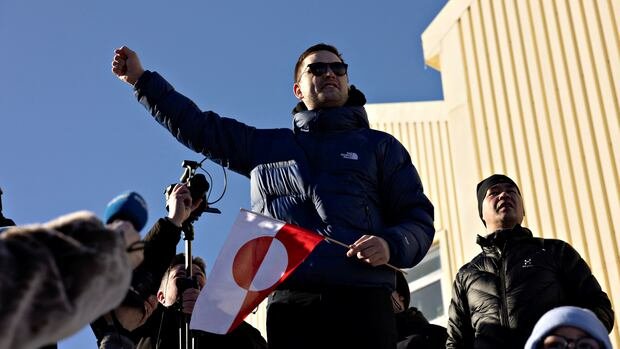
Karla Jessen Williamson was only 11 years old when she was transferred from Greenland to Denmark for schooling during the 1960s, as part of various colonial policies imposed on Greenlanders. In the subsequent years, Greenland has progressively obtained more self-governance from Denmark. However, recent statements from U.S. President Donald Trump regarding a potential acquisition of Greenland have stirred up concerns among the autonomous territory’s residents, including Williamson, who previously served on Greenland’s Reconciliation Commission and now works as an associate professor at the University of Saskatchewan.
Williamson highlighted the complex emotions felt by Greenlanders, describing it as a form of Stockholm syndrome where they feel compelled to revert to past relationships to address the situation. She emphasized the sentiment among Greenlanders, expressing a strong desire neither to be affiliated with the United States nor to remain under Danish rule.
Greenland, with a population of approximately 57,000, has been under the dominion of the Kingdom of Denmark for nearly three centuries. The official abolition of its colonial status occurred in 1953, and in 2009, Greenland was granted an enhanced level of self-governance. Despite this, Denmark still holds responsibility for Greenland’s foreign policy and defense affairs, and the Danish krone continues to be the official currency. Nonetheless, the self-government act outlines a pathway for Greenland to achieve full independence, with a Greenlandic Constitutional Commission proposing strategies for progressing toward autonomy in 2023.
Trump’s recent provocations towards Greenland have injected uncertainty, prompting individuals like Aaju Peter to anticipate a reinvigorated dialogue once the tensions subside. Peter, a lawyer who grew up in Greenland but now resides in Iqaluit across the Davis Strait, expressed optimism about the ongoing efforts towards independence, noting a current collaborative stance with Denmark to present a unified front.
The historical military connections between the U.S. and Greenland trace back to World War II, with a treaty signed in 1941 granting the U.S. military access to safeguard Greenland amid the Nazi occupation of Denmark. Subsequently, in 1951, an updated treaty under NATO established a legal framework for U.S. military bases on the island, primarily as a defense measure against Soviet threats. During the Cold War era, the U.S. maintained multiple military installations in Greenland, which have now consolidated into a single operational facility.
Sara Olsvig, the chair of the Inuit Circumpolar Council based in Nuuk, emphasized the pragmatic need for a robust defense alliance to safeguard Greenland’s interests. While affirming solidarity with Western NATO allies, Olsvig underscored Greenlanders’ commitment to upholding international law, democracy, and human rights. She highlighted climate change as a paramount global challenge requiring collaborative efforts to prevent regional conflicts in the Arctic.
Looking ahead, Williamson stressed the imperative of revitalizing Greenland’s native language, Kalaallisut, regardless of the governance model adopted. Various options exist for Greenland’s future, including independence entailing the creation of a distinct constitution, or a free association model where Denmark retains specific powers during a transition towards economic autonomy. Olsvig indicated that Greenland’s leaders are not currently contemplating severing ties with Denmark entirely but instead aim for a mutually respectful relationship as Greenland progresses towards independence within an alliance framework.