
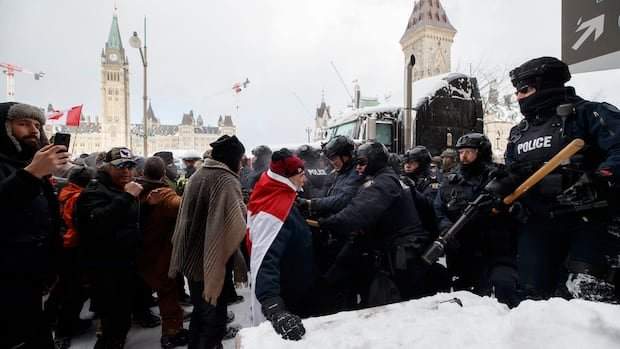
The Federal Court of Appeal ruled on Friday that the Liberal government’s use of the Emergencies Act to disperse the convoy protests in Ottawa and at border points nearly four years ago was deemed unreasonable. The court upheld a 2024 ruling that found former Prime Minister Justin Trudeau’s decision to invoke the legislation unlawful and a violation of protesters’ Charter rights.
In the appeal court’s decision, the three judges stated that while the blockades and convoy protests were disruptive, they did not pose a threat to national security. The court’s ruling came after the Canadian Civil Liberties Association (CCLA) and other groups challenged the government’s declaration of a public order emergency.
The Federal Court initially reviewed the government’s proclamation of a public order emergency in response to the convoy protests. In the 2024 ruling by Justice Richard Mosley, it was highlighted that the government’s decision lacked transparency and justification. The government’s appeal was based on the argument that the protests posed a security threat and that their actions under the Emergencies Act were appropriate.
However, the appeal court concurred with Mosley’s findings, stating that the government did not have reasonable grounds to believe that a national security threat existed, thus failing to meet the legal criteria for invoking the act.
Howard Sapers, the CCLA’s executive director, hailed the court’s decision as a significant victory for the rule of law and the rights of Canadians. The government is currently reviewing the ruling and considering potential next steps, including a possible appeal to the Supreme Court.
The convoy protests, initially a demonstration against vaccine requirements, attracted thousands of participants to Ottawa, resulting in disruptions and complaints from residents. Despite the government’s use of extraordinary powers under the Emergencies Act to disperse the protests, the court found that the measures infringed on protesters’ rights and lacked a sufficient legal basis.
The court’s ruling also questioned the government’s interpretation of a national emergency and its justification for invoking the Emergencies Act. The decision raised concerns about the potential impact on future protests and demonstrations if a broad interpretation of security threats were allowed.
The public inquiry led by Commissioner Paul Rouleau reached a different conclusion in 2023, stating that the government had met the threshold required to invoke the Emergencies Act. However, the court’s decision emphasized the need for a rigorous assessment of national security threats before resorting to such extraordinary measures.
Overall, the Federal Court of Appeal’s ruling regarding the government’s use of the Emergencies Act during the convoy protests underscores the importance of upholding the rule of law and protecting the rights of all Canadians.