
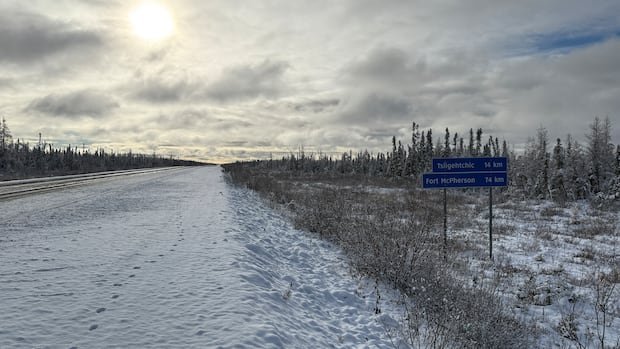
After a quarter-century of supplying essential products such as food to communities in the Northwest Territories, Manitoulin Transport is expressing concerns about its future operations due to escalating road closures caused by climate change. Recently, the company faced challenges with multiple trucks stranded on the Dempster Highway due to prolonged closures triggered by severe weather conditions.
Rob Eskens, the vice president of sales at Manitoulin, highlighted the impact of the situation, emphasizing the anxiety stemming from delays in delivering nine trailer loads of crucial goods to communities eagerly awaiting them. The company is facing financial setbacks from replacing expired goods in stranded trucks and investing additional time in assessing heightened safety risks for drivers. Eskens also recounted a recent incident where one of the company’s drivers had to be rescued following an accident during a highway closure.
To address these issues, Eskens is urging the governments of the Northwest Territories and Yukon to enhance road infrastructure safety measures and bolster snow clearing operations. Binay Yadav, the director of transportation at the N.W.T. Department of Infrastructure, acknowledged the government’s efforts to employ databases for predicting climate change impacts on infrastructure to aid in planning road and highway improvements. However, the financial costs associated with these endeavors pose a significant challenge.
Yadav emphasized the persistent year-round infrastructure challenges linked to climate change and the escalating costs of addressing them. Factors such as a shorter construction window, limited industry capacity for consultants and contractors in the N.W.T., as well as difficulties in accessing remote locations, contribute to the mounting expenses of infrastructure projects in the region.
In the Yukon, the Department of Highways and Public Works is focusing on rehabilitating and reconstructing key corridors like the Dempster Highway, Alaska Highway, and North Klondike Highway, which are particularly vulnerable to climate-related risks such as thawing permafrost, flooding, and erosion.
The N.W.T. Infrastructure department is leveraging research and new technologies to project and mitigate climate change impacts on infrastructure. Collaborations with universities and researchers are underway to enhance infrastructure planning and design through engineering studies like terrain analysis and satellite imaging. However, the territorial government is reliant on federal funding to enhance existing infrastructure and develop climate-resilient solutions.
Moreover, Environment and Climate Change Canada mentioned the federal government’s substantial investment in climate adaptation efforts but did not specify the allocation for the N.W.T. region. The government’s Canadian Centre for Climate Services, in partnership with Crown Indigenous and Northern Affairs Canada, is developing climate data technology tailored to Northern regions to bolster climate resilience measures.
Manitoulin Transport is contemplating the feasibility of continuing road deliveries, given the escalating challenges. With each truckload of expired goods costing approximately $50,000 to replace, the company is exploring alternative transportation modes like air freight. Eskens emphasized the need for enhanced logistics collaboration in the North to navigate potential worsening scenarios in the future.