
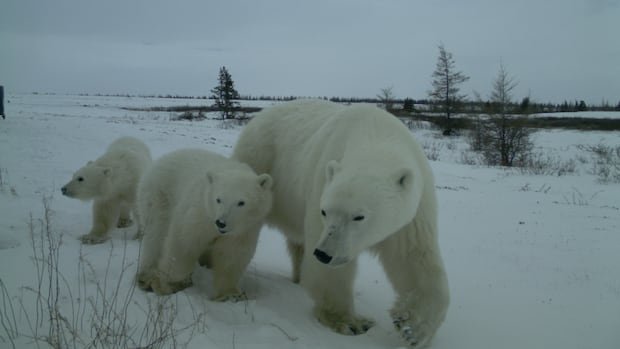
Inhabitants of Canada’s northern regions have noticed a rise in polar bear sightings on land, with bears coming into contact with humans more frequently. Initially, it was believed that these bears, driven ashore due to diminishing sea ice and a lack of their primary food source – ringed seal cubs, were starving and potentially posing a threat to humans.
However, an extensive 11-year study conducted by researchers from the University of Saskatchewan and University of Manitoba has challenged this assumption. Contrary to popular belief, the study revealed that it was not just undernourished bears seeking food that were interacting with humans onshore.
Douglas Clark, a professor at the U of S, explained that their research showed an increase in bear encounters with people regardless of the bears’ body condition, age, or sex, the longer they spent off the ice. This meant that bears of all types were more likely to be seen near human settlements simply because they were spending more time on land.
Clark initiated the study by deploying trail cameras in various locations within Wapusk National Park near Hudson Bay, monitoring polar bear activities over the years. The research aimed to understand why these encounters were becoming more frequent and if the bears were intentionally approaching humans for food.
Observations from over 500 polar bear visits, along with sea ice measurements and human activity data, were compiled over the study period. The findings, recently published in Arctic Science, indicated that the bears were not specifically targeting humans for food but were being driven ashore more frequently due to climate change-induced sea ice loss.
Although some bears were indeed hungry, there was no evidence to suggest that they were actively hunting humans. Clark emphasized that while nutritional stress played a part, it did not lead to a mass migration of starving bears into communities. Additionally, Alex Crawford from the University of Manitoba highlighted the importance of recognizing that polar bears, even when starving, were not inherently more aggressive towards humans.
The research team plans to continue monitoring polar bear behavior to assess any long-term changes resulting from alterations in their habitat and food sources.