
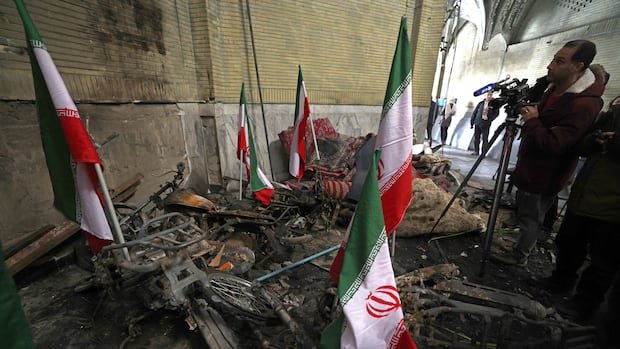
Iran’s chief prosecutor disputed U.S. President Donald Trump’s assertions that he stopped the hangings of 800 detained protesters, labeling them as false. Meanwhile, the death toll from the violent crackdown on nationwide demonstrations has surged to at least 5,032, according to activists.
Concerns are mounting as activists struggle to verify information due to an extensive internet blackout in Iran lasting over two weeks. The escalating tensions between the United States and Iran coincide with the approaching American aircraft carrier group to the Middle East, a move Trump likened to an “armada” in his recent remarks to the media.
Experts suggest that the military buildup could potentially pave the way for Trump to initiate strikes, despite his reluctance thus far, despite repeatedly cautioning Tehran. Trump had previously identified the mass execution of prisoners as a trigger for military action, alongside the killing of peaceful protesters.
Although Trump seems to have backtracked on his stance, likely influenced by regional pressure and the realization that airstrikes alone may not be sufficient to destabilize the regime, military assets are still being deployed to the region, hinting at the possibility of kinetic action, as outlined by the New York-based think tank, the Soufan Center.
In a different development, the top prosecutor of Iran, Mohammad Movahedi, refuted Trump’s claims about halting the execution of detained individuals, emphasizing that such assertions were baseless. Movahedi clarified that the judiciary had not made any decisions regarding the alleged halting of executions.
Notably, some detainees have been labeled as “enemies of God” by judiciary officials, a charge that carries the death penalty. This label had been utilized in the past, including during mass executions in 1988 that claimed the lives of at least 5,000 individuals.
The latest figures indicate that the death toll now stands at 5,032, with 4,716 of the deceased reportedly being demonstrators, 203 government-affiliated, 43 children, and 40 civilians not participating in the protests. Additionally, over 27,600 people have been detained in a widespread crackdown by authorities.
Amid these developments, the United States has deployed additional military resources toward the Middle East, including the aircraft carrier USS Abraham Lincoln and accompanying warships. Trump has suggested that these moves are precautionary, expressing hope that military action may not be necessary.
Furthermore, Trump referenced previous discussions between American officials and Iran regarding the nuclear program before Israel’s actions against Iran. He warned of potential military action against Iran, emphasizing the need for a deal to avert conflict.
Iran’s Foreign Ministry, under the leadership of Abbas Araghchi, has engaged in negotiations with U.S. envoy Steve Witkoff over Iran’s nuclear program in an attempt to defuse tensions.
These recent developments underscore the escalating tensions between the U.S. and Iran, with the situation remaining fluid and uncertain.