
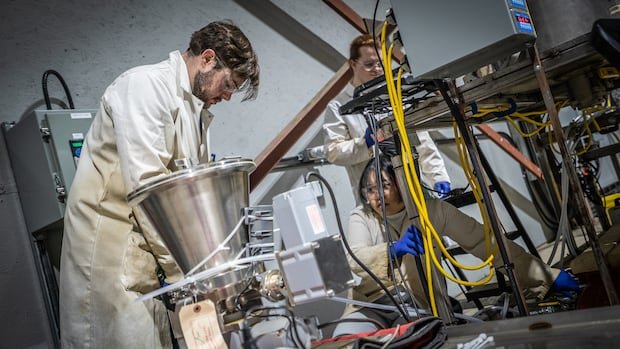
Researchers in Sudbury, Ontario, are currently engaged in efforts to upscale bacteria-powered technology for extracting valuable metals from old mine waste. MIRARCO Mining Innovation is conducting tests at a pilot facility to explore the potential of using microbes to breakdown mine tailings, which are the residual rock and sediment from mining activities. This process, known as bioleaching, aims to release critical minerals like nickel, cobalt, and copper.
Although bioleaching technology is widely utilized in international mining operations, with around 30 mine sites globally employing it, Canada has not yet implemented full-scale commercial deployment, as highlighted by Nadia Mykytczuk, CEO of MIRARCO. During a recent tour of the 10,000-square-foot pilot facility in Sudbury, Mykytczuk shared insights on the bioleaching process and its significance.
The pilot facility, where researchers began their work in May, represents years of preparation. According to Mykytczuk, the tailings in Sudbury alone contain approximately $8 billion to $10 billion worth of nickel, underscoring the substantial potential for recovering valuable minerals from this waste material.
Despite the significant value of mine tailings, companies have been hesitant to invest in their reprocessing due to the high costs associated with transporting the material back to smelters. Consequently, tailings are typically stored in large ponds mixed with water, raising long-term environmental concerns.
Jaime Kneen from MiningWatch Canada emphasized the environmental risks associated with storing tailings, particularly the potential for chemical reactions generating acid and releasing metals into the surrounding environment. The stability of tailings storage facilities is crucial, as highlighted by the consequences of the 2014 Mount Polley mine tailing dam collapse in British Columbia, which resulted in the release of toxic mine waste into nearby water bodies.
In response to the growing demand for critical minerals for clean energy technologies and national defense, both federal and provincial governments are urging increased development of these resources. Mykytczuk noted that bioleaching not only addresses the demand for critical minerals but also offers solutions for mining cleanup, presenting a significant opportunity to extract valuable minerals from mine waste.
The bioleaching process involves grinding down tailings and mixing them with a liquid solution to feed bacteria, which break down the minerals, allowing the extraction of metals. Researchers are working to replicate this process on a larger scale for practical implementation in mining operations, emphasizing the continuous movement of material through tanks to enhance efficiency.
Furthermore, the team is exploring ways to convert the extracted metals into industrially viable products. By demonstrating the commercial value of these processed materials, they aim to transition from pilot testing to full-scale operations within the next two to three years in Canada.