
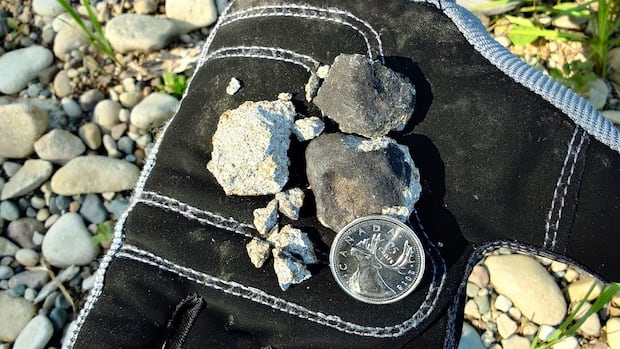
Meteorite fragments from a significant fireball event witnessed across northern Ontario skies last month have been found on Cockburn Island in Lake Huron. Dave Kenny, a resident of Vancouver Island, and his colleague Anton Clemens, who are part of the volunteer group Meteorite Recovery Specialists, made the discovery on July 11. Cockburn Island is sparsely populated and situated off the western tip of Manitoulin Island in Lake Huron’s North Channel.
The samples recovered by Kenny and Clemens were analyzed by the Meteor Physics Group at Western University in London, Ontario. It was confirmed that the rocks originated from a meteor that disintegrated in the atmosphere on June 19 around 8 p.m., weighing several hundred kilograms.
This discovery holds special significance for Kenny, as it marks his first successful meteorite recovery on Canadian soil. Accessing the fragments on Cockburn Island was a challenging task due to much of the land being privately owned or protected. Kenny had to coordinate extensively with the Cockburn Island council and the Nature Conservancy of Canada to determine the search areas.
The island is only accessible by boat, so Kenny and Clemens camped at Meldrum Bay on Manitoulin Island and were ferried to Cockburn Island by a friend with a sailboat. They spent two and a half days on the island, covering nearly 50 kilometers on foot each day. Despite the challenges, they discovered several meteorite pieces, with the largest weighing 57.6 grams.
The colleagues found intact stones along the township roads and public access areas on the island. The recovered meteorites, suspected to be chondrites from the asteroid belt between Mars and Jupiter, will undergo further study at Western University over the next six months.