
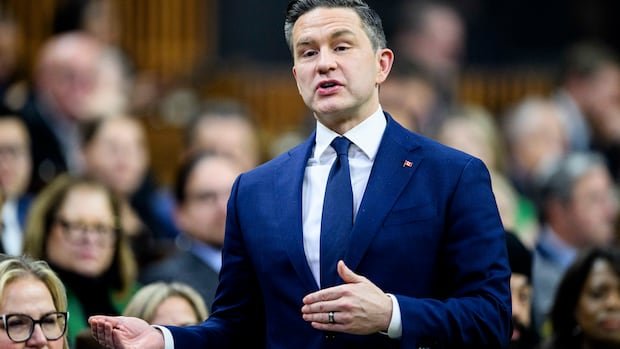
Conservative Leader Pierre Poilievre recently commended the prime minister’s speech in Davos, Switzerland, describing it as “well-crafted and eloquently delivered.” However, in a detailed six-page statement released on Thursday, Poilievre also scrutinized Mark Carney’s efforts in reducing Canada’s dependence on the United States.
Poilievre acknowledged Carney’s emphasis on the need for Canada to become more self-reliant and collaborate with like-minded nations. He expressed the Conservatives’ readiness to work alongside the prime minister to translate these aspirations into tangible outcomes.
While appreciating the tone shift in his response, Poilievre did not hold back from criticizing the Liberal government’s economic policies. He highlighted the disparity between promises and actual outcomes, stating that the Liberals have exacerbated Canada’s economic costs and reliance during their tenure.
Carney’s recent address at Davos has garnered global acclaim for his candid evaluation of the prevailing world dynamics and his call for middle powers to unite against major powers leveraging economic integration as a weapon. Although not directly naming the U.S., the implications were evident, leading to a rebuke by U.S. President Donald Trump the following day.
Poilievre, known for his skepticism towards the World Economic Forum, reiterated his party’s stance to prohibit Conservative government ministers from attending the event. He criticized the Liberals for using the forum to promote what he termed a “radical woke agenda,” contrasting this approach with the Conservatives’ priorities.
In response to Carney’s speech, Poilievre took two days to analyze the content meticulously before issuing his statement. He emphasized the importance of Canada’s trade relationship with the U.S., acknowledging the significance of diversification while underscoring the enduring nature of Canada’s ties with its southern neighbor.
Poilievre extended an offer to collaborate with the Prime Minister in addressing U.S. tariffs and reiterated Conservative support in revitalizing trade talks, including engaging with U.S. Vice-President JD Vance. However, he cautioned against strengthening ties with nations deemed hostile, such as China.
Looking ahead, Poilievre outlined his forthcoming proposal, the Sovereignty Act, aimed at enhancing Canada’s affordability, self-reliance, and sovereignty. The plan includes measures to eliminate capital gains tax on reinvestment in Canada and revoke anti-pipeline regulations to expedite approvals for pipelines to Asia.
Additionally, Poilievre reintroduced initiatives from his election campaign, focusing on resolving the recruitment challenges in the Canadian Armed Forces. These proposals encompass re-establishing a permanent military presence in the Arctic, augmenting the Canadian Rangers, and accelerating upgrades to submarines, helicopters, and Northern support facilities.