

A comprehensive bill proposed by the Ford government may allow Ontario to incinerate more garbage for energy production while tackling the increasing landfill issue, though critics argue that incineration negatively impacts air quality and undermines efforts to reduce waste.
Last month, the province unveiled Bill 140, which includes provisions for the establishment of additional landfills and waste-to-energy plants throughout Ontario. Environment Minister Todd McCarthy stated that there are no current proposals in front of the province, but the legislation serves as an invitation for private developers to present projects to Ontario and local municipalities.
“It is a rallying cry,” he expressed during a media briefing at Queen’s Park. “If we cannot manage our waste effectively and in a diverse manner, we will encounter significant challenges.”

Waste burns inside one of the incinerators at the Durham York Energy Centre. Approximately 35 trucks deliver waste daily to be processed at the facility. (Paul Borkwood/CBC News)
Ontario confronts imminent landfill capacity challenges
The province introduced the legislation to tackle a looming shortage of landfill space statewide, with experts forecasting that Ontario could exhaust its landfill capacity within a decade.
Currently, Ontario exports over 3 million tonnes of waste annually to the United States, which has imposed a 50 percent tariff on it.
The proposed bill would eliminate the existing power municipalities have to veto landfill projects in their jurisdictions. McCarthy’s office did not answer inquiries from CBC News regarding whether this would also apply to waste-to-energy incinerators.
However, McCarthy indicated to the press that he views waste-to-energy as a component of a waste diversion strategy aimed at minimizing the volume of garbage sent to Ontario’s landfills. When asked whether he would support having one in his neighborhood, he noted that a facility already operates in his community, near Courtice, Ontario.
“I have an energy-from-waste plant in my riding, and it is well-accepted by the community,” McCarthy remarked.

Andrew Evans, director of waste services and compliance for Durham Region, states that the Durham York Energy Centre generates sufficient electricity to power 10,000 homes and diverts 140,000 tonnes of waste from landfills annually. (Paul Borkwood/CBC News)
Waste-to-energy facility processes 140,000 tonnes of waste each year
The $284-million Durham York Energy Centre was developed by the regions it serves via a public-private partnership. A private firm, ReWorld, operates the facility alongside the regional authorities.
It stands as one of just two waste-to-energy incinerators currently functioning within the province.
Inaugurated in 2016, the facility now diverts 140,000 tonnes of household waste annually. Around 35 trucks deliver waste each day for incineration, which in turn provides energy for approximately 10,000 local residences.
“In addition, we are recovering metals, generating electricity for the grid, and minimizing the volume and weight of materials sent to landfills,” commented Andrew Evans, director of waste services and compliance for Durham Region.
The plant is regarded as part of an array of solutions aimed at preventing waste from being buried, according to Lindsay Milne, director of waste management and forestry for York Region.
“Our approach prioritizes reduction, reuse, and recycling,” Milne stated, noting that the facility aids in recovering energy for local consumption. “It offers greater benefits than landfilling and aligns with our long-term strategies.”
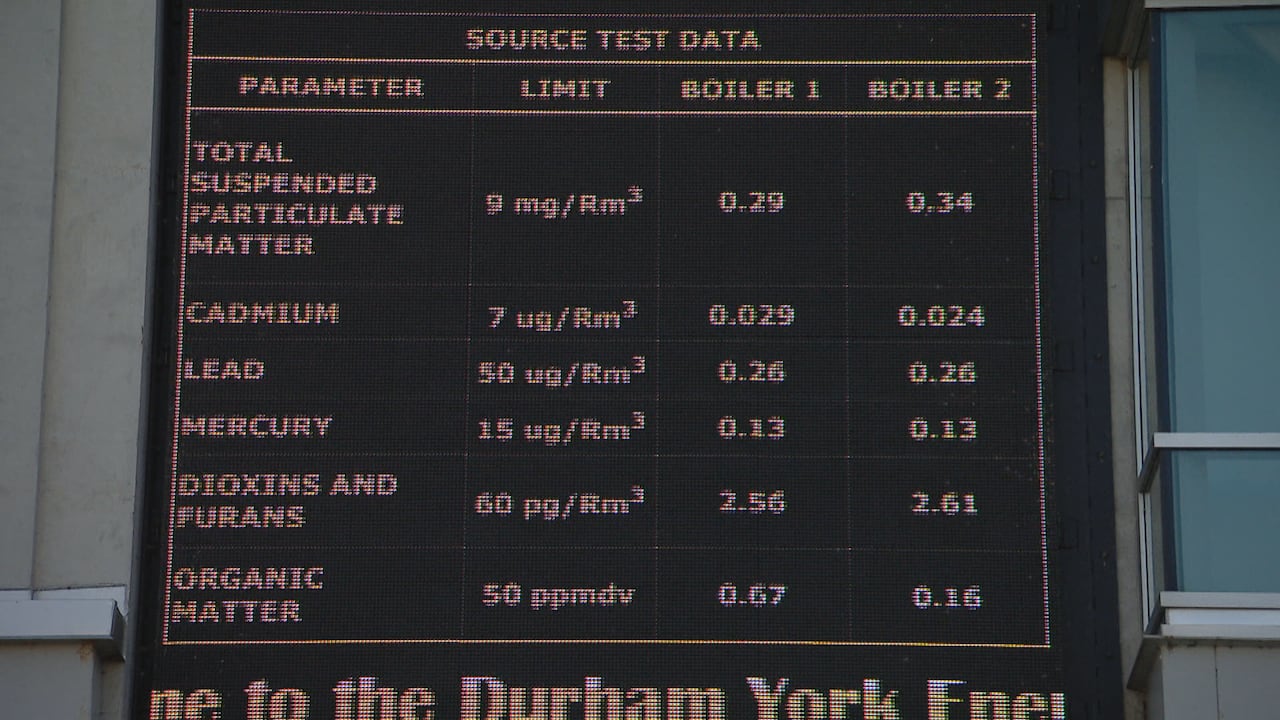
A digital display at the Durham York Energy Centre shows real-time monitoring of emissions. Critics argue that incinerators release toxic pollutants and greenhouse gases into the environment. (Paul Borkwood/CBC News)
Critics highlight pollutant issues from waste-to-energy processes
Nevertheless, waste-to-energy facilities face opposition.
According to Karen Wirsig, senior program manager for plastics at Environmental Defence, burning waste leads to increased greenhouse gas emissions, generates harmful pollutants, and diminishes the incentives for recycling and reusing products.
“Incineration is costly and significantly polluting,” she emphasized. “It encourages the destruction of resources that should be handled differently.”
“It appears that [the province] intends to pressure local communities into accepting these facilities, regardless of their preferences,” she added.
Evans noted that emissions from the center are treated on-site and meticulously monitored with publicly accessible real-time data.
“The plant adheres to stringent emission standards mandated in Ontario, and we strive to enhance plant efficiency to consistently remain well under those limits,” he remarked.
While the facility can reduce the amount of waste it processes by up to 90 percent, an ash by-product still has to be sent to both landfill and hazardous waste sites for disposal.
-
Toronto’s main landfill could be full in just 10 years. The city’s racing to come up with a solution
-
Ontario should burn more garbage, build more landfills, environment minister says
Green party leader Mike Schreiner challenges McCarthy’s claim that Durham residents have welcomed the facility. Early in his political career, he participated in numerous protests opposing its construction.
Schreiner continues to believe that waste-to-energy facilities are not the appropriate solution.
“Incineration is one of the most costly methods for waste management, and it would be far more economical to recycle, repair, and compost much of our waste, which would also generate significantly more jobs,” he stated.
Calvin Lakhan, director of the Circular Innovation Hub at York University, acknowledged the negative perception of incineration concerning pollution, but noted that advancements in technology have occurred over the last forty years.
Although he claims not to advocate for waste-to-energy, he believes the province is running out of time to devise solutions due to its own inaction.
“While there are valid concerns, any health risks should be addressed as effectively as possible, but sometimes one must choose the lesser of two evils,” he remarked.
Bill 140 has successfully passed its second reading in the legislature and may be enacted into law in the upcoming weeks. The Durham York Energy Centre has submitted a request to process an additional 20,000 tonnes of waste per year, which is currently under review by the province.
Tag: rewrite-pending