
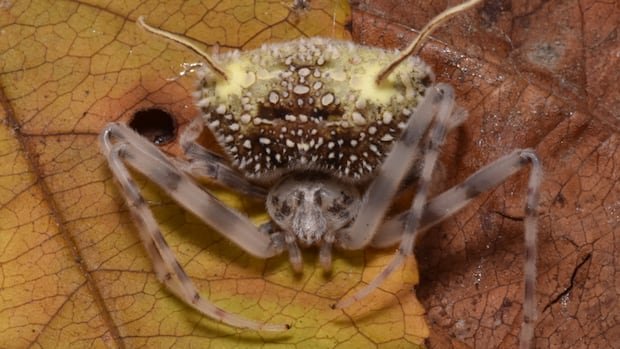
During an expedition in August 2025, scientist Alexander Bentley encountered a surprising sight when he discovered a spider seemingly thriving beneath what he initially thought was a lethal parasitic fungus. Bentley, a herpetologist based in Ecuador, frequently guides tours in the Amazon rainforest and is familiar with cordyceps, a type of parasitic fungus known for infecting insects and arachnids, altering their behavior akin to zombies.
The spider Bentley found had developed distinctive tendril-like structures called tubercles on its abdomen, typically indicating a cordyceps infection. Initially mistaking it for a fungus-infected spider, Bentley later realized it was an entirely new arachnid species that appeared to imitate fungus like cordyceps, potentially for hunting or defense purposes. The discovery was detailed in a publication by Zootaxa.
Following this intriguing find, Bentley sought assistance from the citizen-science platform iNaturalist to identify the spider. Despite initial speculation that the spider mimicked a specific parasitic fungi, further analysis confirmed it as a new spider species named Taczanowskia waska. The identification process involved detailed morphological examinations by Bentley and his colleague, David Ricardo Díaz-Guevara, an arachnid curator in Ecuador.
The peculiar appearance of the spider has sparked debates among scientists. While some believe it mimics the fungus as a hunting strategy or defense mechanism, others suggest the resemblance may serve other purposes. Regardless, experts like mycologist Monika Fischer from the University of British Columbia express enthusiasm about the discovery’s significance and the role of citizen-science platforms like iNaturalist.
Andrew Swafford, an associate biology professor from Middlebury College, Vermont, highlights the ambiguity surrounding the spider’s mimicry and calls for further research to understand its purpose fully. If confirmed, this unique spider would represent a remarkable discovery, surpassing Bentley’s previous encounters in the rainforest.
The findings shed light on the intricate interactions between species in the Amazon rainforest and emphasize the importance of ongoing scientific exploration in uncovering nature’s mysteries.