
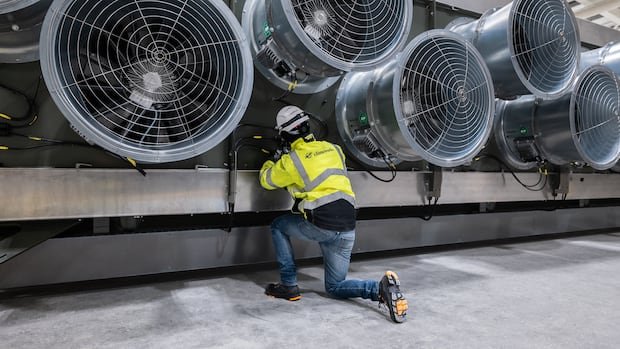
A Swiss firm specializing in carbon capture is establishing its Canadian base in Calgary. Climeworks, known for pioneering commercial direct carbon capture technology, extracts carbon dioxide from the air for underground storage. Currently, a small team is operating from a shared space in downtown Calgary provided by the Energy Transition Centre foundation.
In the upcoming fall, Climeworks plans to operate a mobile testing facility to assess the technology’s performance in Alberta’s cold winter conditions. The facility, currently undergoing tests in Saudi Arabia, will be transported to Alberta during the summer.
The company’s next focus is on constructing a large-scale plant, potentially their most significant project yet. While the exact timeline and location are pending, Climeworks has confirmed it will be situated somewhere in Alberta. Presently, Climeworks operates two direct air capture plants in Iceland, with the larger plant, named Mammoth, targeting the removal of 36,000 tonnes of carbon dioxide annually, equivalent to the emissions of approximately 8,400 vehicles per year.
Moreover, Climeworks recently formed a partnership with Coca-Cola to utilize captured carbon for carbonating sparkling water. The company, founded by Christoph Gebald in 2009, is expanding its workforce locally in Calgary.
Alberta is recognized as a global leader in carbon dioxide removal, with favorable conditions such as expertise from the energy sector, regulatory support, suitable geological formations for carbon storage, and significant tax incentives from provincial and federal governments. Jorden Dye of the Pembina Institute’s Carbon Dioxide Removal Centre highlighted Alberta’s increasing attractiveness for such projects, especially with the declining U.S. support for direct carbon capture initiatives.
Another company, Montreal-based Deep Sky, commenced carbon capture operations in Innisfail, Alta., last year. Climeworks, with a global workforce of approximately 400 employees, is expected to hire more staff in the Calgary region. Gebald mentioned a recent 10% reduction in the workforce as a necessary adjustment following substantial growth in previous years.