
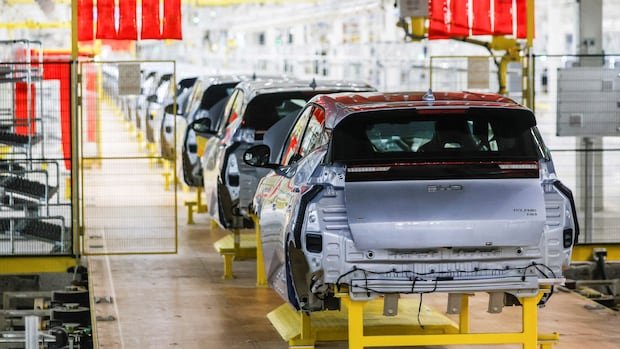
The Canadian market officially welcomed Chinese-made electric vehicles on March 1, but popular brands like Polestar, Volvo, and Tesla are expected to enter Canada first. Peter Frise, a mechanical and automotive engineering professor at the University of Windsor, explained that Chinese EVs from brands not currently imported to Canada may face a longer process to enter the market.
Chinese electric vehicles, including well-known brands like BYD, Chery, and Geely, are typically priced lower due to cost-efficient materials, labor, and Chinese government subsidies. Despite this, non-Chinese brands such as Volvo, Polestar, and Tesla, which also manufacture in China, could benefit from Prime Minister Mark Carney’s recent EV deal announcement.
While China produced 12.4 million EVs in 2024, aiming for annual global sales of 40 million EVs in the near future, Frise noted that Chinese companies possess surplus manufacturing capacity and must export vehicles to keep their factories operational. However, with a limit of 49,000 Chinese-made EVs allowed into Canada at a 6.1% tariff rate, these companies will strategically choose which models to export to maximize profits.
Addisu Lashitew, an associate professor at McMaster University, suggested that Teslas, Polestars, and Volvos could arrive in Canada soon, while the permitting process might take longer for Chinese brands. Lashitew also highlighted the importance of streamlining procedures to avoid delays and maintain market access.
In terms of approval processes, vehicles made in China for the Canadian market must comply with safety regulations. Transport Canada’s Appendix G Pre-clearance Program facilitates the registration of foreign manufacturers that meet Canadian standards, ensuring efficient border processes. Compliance includes inspections of various vehicle components, a process that can take several weeks or months. BYD is the only Chinese EV with this clearance currently.
Transport Canada and Global Affairs were reached out to for approval timeline inquiries, but responses were not received by the deadline. Chinese auto manufacturers like Chery and Xiaomi were also contacted regarding approval applications, but no responses were received. While Tesla did not comment, a Polestar spokesperson mentioned ongoing evaluations of market developments.