
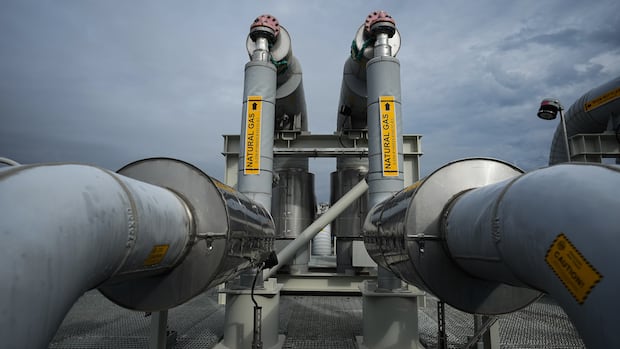
Prime Minister Mark Carney asserts that Canada plays a significant role in driving American economic growth by exporting natural gas to the United States. His recent speech raises the question of the potential consequences if Canada were to cease these exports.
Despite the ongoing trade tensions between Canada and the U.S., energy products like oil and natural gas have not been utilized as bargaining chips. While Alberta Premier Danielle Smith has consistently opposed this tactic, Ontario’s Doug Ford believes all options should be considered.
Carney highlighted the importance of Canada’s energy exports to the U.S., stating that Canada supplies 99% of their natural gas imports, 85% of their electricity imports, and 60% of their crude oil imports. However, the actual impact of natural gas imports is relatively small compared to the total U.S. natural gas consumption.
According to Dulles Wang, director of Americas gas and LNG at Wood Mackenzie, the flow of natural gas between Canada and the U.S. is constant and bidirectional. While the U.S. primarily imports Canadian gas for certain markets, it also exports gas back to Canada for other regions.
Although Canadian natural gas shipments to the U.S. may be minor in comparison to U.S. domestic production, the geographical distribution of these deliveries is crucial. For instance, a significant portion of natural gas consumed in the Pacific Northwest region originates from Canada.
Halting natural gas exports to the U.S. would have severe repercussions for the Canadian industry, leading to an oversupply and plummeting prices. Wang emphasized that such a move would be detrimental to Canada, as it would eliminate its primary customer and destabilize the market.
In an effort to diversify its energy export destinations, Canada has begun sending liquefied natural gas to Asian markets from facilities like LNG Canada in Kitimat, B.C. The government is also supporting additional projects to expand Canada’s energy export capabilities beyond its reliance on the U.S. market.