
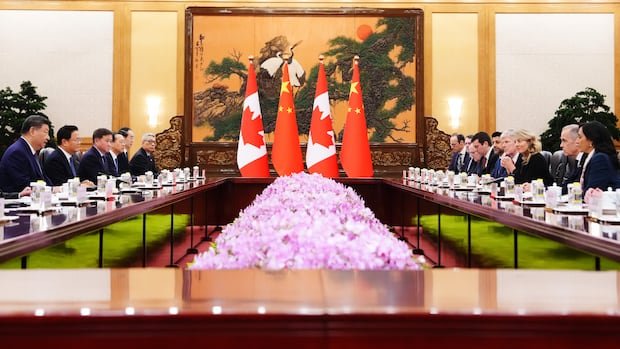
The Canadian government and China have reached a significant agreement, described by Prime Minister Mark Carney as a “landmark” deal. Carney emphasized the partnership as a reflection of the current world dynamics, characterized by a realistic, respectful, and interest-based engagement.
The agreement involves adjustments to tariffs on specific products. Notably, Canada will permit the entry of 49,000 Chinese electric vehicles into its market at a reduced tariff of 6.1%, following Ottawa’s earlier imposition of a 100% tariff on all Chinese EVs in 2024. In return, China is expected to decrease tariffs on Canadian canola to 15% by March and eliminate tariffs on Canadian canola meal, lobsters, crab, and peas until at least the end of 2026.
While progress has been made in addressing issues related to Canadian pork exports, Chinese tariffs on pork remain unchanged. The recent developments follow a series of tariff disputes that escalated over the past year, triggered by Canada’s imposition of tariffs on Chinese electric vehicles in 2024, mirroring a similar action by the United States.
Prime Minister Carney’s engagement with Chinese President Xi Jinping in recent months has been hailed as a turning point in Canada-China relations. The deal’s potential impact on the upcoming review of the Canada-U.S.-Mexico Agreement is being closely monitored, with differing reactions from various stakeholders, including provincial premiers and industry representatives.
Premier Scott Moe of Saskatchewan welcomed the agreement, emphasizing its positive implications for Canada-China relations and the agricultural industry. In contrast, Ontario Premier Doug Ford expressed concerns about the deal, particularly its implications for the auto sector. Industry players have also expressed mixed reactions, with some viewing the agreement favorably for providing clarity and others raising concerns about potential risks to the automotive industry.
Amidst the varied responses, industry representatives like Flavio Volpe and union leaders like Lana Payne have called for measures to safeguard Canadian interests and ensure compliance with safety standards. The deal’s impact on the Canadian auto industry remains a point of contention, highlighting the complexity and diverse perspectives surrounding the agreement.