
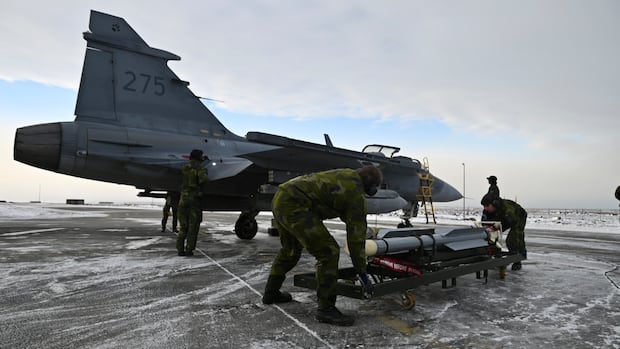
In an effort to persuade Canada to acquire Gripen-E fighter jets, Saab has proposed setting up a secure, sovereign data centre in Montreal dedicated to storing vital, classified mission data and intelligence, according to information obtained by CBC News.
The company presents this as a “distinct advantage” in its endeavor to sway the administration of Prime Minister Mark Carney to reconsider the procurement of U.S.-made F-35s, which have all data managed at a Lockheed Martin facility in Fort Worth, Texas.
Saab spokesperson Sierra Fullerton confirmed in a recent statement to CBC News that the specialized data centre “will manage all operations related to the fighter mission system.”
The facility would employ Canadians with “Canada/U.S. security clearance,” likely to oversee information pertinent to North America’s defense through the North American Aerospace Defence Command (NORAD).
“Gripen data will also be securely stored within Canadian borders,” Fullerton stated. “By hosting the fighter mission system, communications, and technical data in Canada, Gripen fulfills all industrial, security, and controlled goods regulations.”
“With Gripen, the Royal Canadian Air Force will gain complete, independent authority over aircraft, software, and sensitive information.”
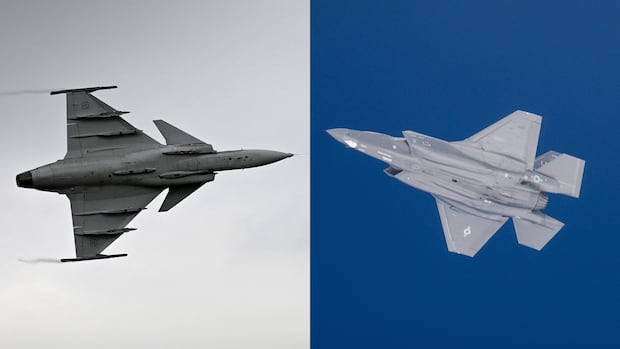
With the future of Canada’s fighter jet fleet being re-examined, CBC’s Murray Brewster breaks down the differences between the American F-35 and Sweden’s Gripen.
It has been over a year since Carney initiated a review of Canada’s F-35 acquisition, which has been under contract since January 2023. Although no formal conclusions or decisions have been declared, the federal government has permitted the procurement of components for the assembly of additional stealth jets, in addition to the 16 aircraft already ordered.
As an alternative to the F-35, Saab is proposing a comprehensive package that includes 72 Gripen E/F fighter jets and six GlobalEye airborne early warning and control (AEWAC) aircraft.
The company suggests assembling these jets domestically, aligning with Carney’s aim to enhance the Canadian economy through defense investments.
However, the topic of data sovereignty resonates deeply.
As tensions with the Trump administration persist and the U.S. president continues to criticize NATO, along with concerns from senior U.S. officials about the future of the alliance, Carney has prioritized establishing data sovereignty on a large scale.
A sovereign data centre for the nation’s warplanes would ensure that critical mission-related, operational, and intelligence data stays within the country’s borders, asserted Jussi Halmetoja, a test pilot and operational advisor to Saab, during a recent interview.
-
Analysis
Trump rages, NATO endures: Why the alliance is harder to kill than it looks
-
Saab says Canada’s air force could have Gripen fighter jets in as little as 3 years
-
Analysis
U.S. could hold a ‘red card’ over Canada’s Gripen fighter jet option
“What this truly provides is sovereignty — the ability to control the data you gather and own it,” he explained.
Halmetoja stated that the centre would block unauthorized access by foreign nations and safeguard against extraterritorial regulations, such as the U.S. CLOUD Act, which might permit foreign entities to demand data stored on their servers.
“You can collect your data, analyze it within your own country without external interference,” Halmetoja noted.
Concerns regarding data protection and management among the international partners in the F-35 program have been a subdued issue for nearly a decade.
In 2018, the Pentagon’s joint project office overseeing the fighter program awarded a $26-million US contract to Lockheed Martin to isolate each nation’s data and establish firewalls to prevent the transfer of sensitive information collected by the jet — whether mechanical or mission-related.

Pete Hoekstra, U.S. President Donald Trump’s ambassador to Canada, warned about potential consequences to the NORAD continental defence pact if Canada doesn’t complete the purchase of 88 F-35 fighter jets and instead buys Sweden’s Gripen jets.
The online defense industry publication The War Zone (TWZ) extensively covered the Joint Strike Fighter’s Autonomic Logistics Information System, now updated and renamed the Operational Data Integrated Network (ODIN), which collects a vast amount of data for aircraft maintenance, potentially exposing it to cyber threats.
Concerns regarding cyber vulnerability were raised by the Pentagon’s Office of the Director of Operational Test and Evaluation.
Moreover, the F-35 gathers a variety of sensitive information from other countries, such as flight path data, mission profiles, communications information, video images, electronic signatures, and the locations of both friendly and enemy radars, as well as insights into allied nations’ tactics, techniques, and procedures.
Among the solutions discussed publicly, Defence News reported in 2019 that F-35 operators can restrict some systems from transmitting data back to the United States. Italy and Norway have reportedly implemented interim firewalls at Eglin Air Force Base to manage data sharing.
The effectiveness of these changes remains unclear, as the Pentagon altered its reporting methods regarding F-35 technical and serviceability issues in 2022.
F-35 maker claims to have resolved data concerns
When asked about Saab’s data centre proposal, a senior Lockheed Martin official stated that the company has addressed all relevant concerns.
“As part of our government contracts, we provide all necessary system infrastructure and data for all F-35 customers to operate and maintain their aircraft independently while meeting their sovereign requirements and operational needs,” Chauncey McIntosh, vice-president and general manager of the F-35 program, stated in a recent written response.
Daniel Araya, a leading authority on data sovereignty and a fellow at the Centre for International Governance Innovation (CIGI), noted that the Canadian and U.S. military forces have collaborated closely for decades and are likely to continue doing so.
“However, for now, we look to U.S. leadership when we question our trust in that relationship,” Araya mentioned in a recent discussion.
He emphasized that Canada’s geographical position will always keep it somewhat reliant on the U.S. security framework.
-
Saab sees Canada as ‘great’ partner to design next-generation fighter jets
-
Saab wants Canada to buy 72 Gripens and 6 GlobalEyes to fulfil promise of 12,600 jobs
“If we aim to preserve our sovereignty in the face of the United States potentially moving in directions that make us uneasy — something that could persist beyond the Trump administration — we must consider asserting our autonomy at the levels of energy, infrastructure, software, and data,” he concluded.
He also pointed out an essential and perhaps overlooked technological aspect. The data being collected is utilized to train AI models. If this data is solely owned by one company in one nation, it poses a competitive challenge with implications for sovereignty.
“Relying on the United States, its data pathways, software, and broader security frameworks ultimately makes us dependent on the U.S. not just for security, but for everything else that data influences and feeds into,” he stated.