
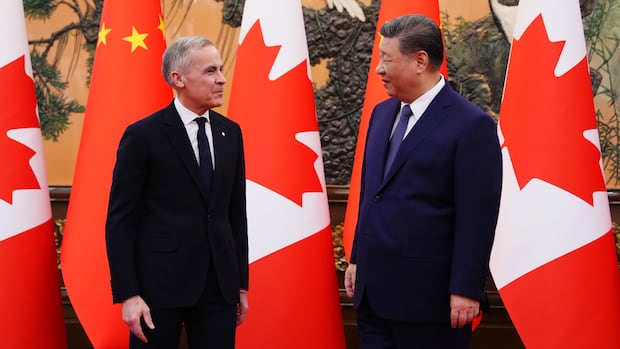
U.S. President Donald Trump showed little concern when questioned about Prime Minister Mark Carney’s recent trade deal with China, stating that such agreements are beneficial and should be pursued. The prospect of reaching a deal had been widely discussed for over a year leading up to the delegation’s visit to Beijing this week.
The key challenge for Carney was to secure a deal that would not upset the auto industry or Ontario Premier Doug Ford while navigating the upcoming review and renewal of the Canada-U.S.-Mexico Agreement (CUSMA). The goal was to avoid any negative impact on North American trade relations.
The agreement with China initially allows for 49,000 electric vehicles to enter Canada, representing a small fraction of total vehicle sales, and includes reductions in Beijing’s tariffs on canola products. Market strategist Jim Thorne views the deal as a test of boundaries for the U.S. administration.
While some American media outlets portrayed the deal as a move away from the U.S., it is seen by experts as a potential reference point for the Trump administration rather than a direct challenge. Concerns were raised by U.S. officials regarding the impact on American auto workers, but they do not anticipate significant disruptions in Canada-U.S. trade flows.
Experts suggest that the U.S. administration may have tacitly approved the agreement, possibly through informal channels, as part of a broader strategy. The reaction from U.S. officials indicates a degree of acceptance, with expectations that the deal will not significantly alter bilateral relations.
It remains to be seen how the U.S. will ultimately respond to the deal with China, with speculation that they may seek similar arrangements in their own negotiations. The evolving dynamics between the two countries will likely shape future trade interactions, with both sides closely monitoring each other’s moves.