
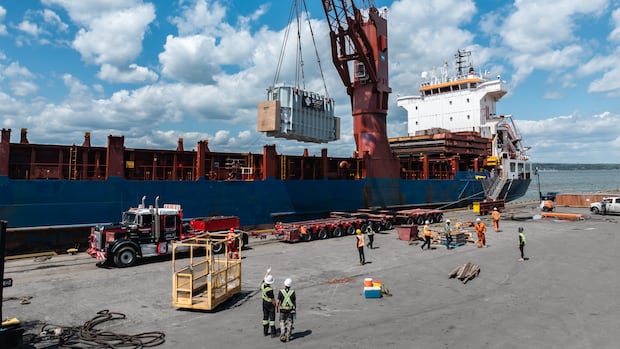
Political and industry leaders are advocating for increased freight movement on the Great Lakes as a solution to truck congestion and emissions reduction. However, experts emphasize that significant investments are required from both governments and businesses to make this transition successful.
During the annual meeting of the Great Lakes and St. Lawrence Cities Initiative in Hamilton, municipal leaders from Canada and the United States discussed the potential benefits of marine shipping on the Great Lakes. According to Jonathan Altenberg, the president of the Great Lakes and St. Lawrence Cities Initiative, the current capacity of the St. Lawrence River is underutilized, at less than 50%.
Mayor Andrea Horwath highlighted Hamilton’s role in the “Fresh Coast Economic Corridor,” a major economic region generating $9 trillion USD in economic activity. She emphasized the importance of collaborating with stakeholders to alleviate congestion on highways like the QEW and Highway 403 by shifting cargo from trucks to ships.
Elkafi Hassini, an associate dean at McMaster University, emphasized the advantages of marine transport for bulk goods such as steel, grain, and sugar. He pointed out that a single vessel can transport the equivalent of hundreds of truckloads, potentially reducing significant freight traffic on highways while offering cost savings and emission reductions.
Despite the environmental benefits, both Hassini and Ian Borsuk, the executive director of Environment Hamilton, acknowledged practical challenges facing marine shipping, such as slower transit times and the need for significant volume for cost-effective operations. They also highlighted the importance of public and private investments in developing the necessary infrastructure for a successful transition.
Hassini sees Hamilton as having the potential to become a key logistics hub due to its strategic location, including its port, airport, and highway connections. He suggested a model where cargo arriving at the airport could be transferred to the port for distribution via barges, reducing reliance on road transport.
While environmental groups cautiously support the shift towards marine shipping to reduce truck traffic and noise pollution, they also express concerns about potential environmental impacts on the Great Lakes, a vital source of drinking water for millions. Borsuk stressed the need for careful planning to ensure economic growth does not compromise environmental protections.
Overall, experts agree that a significant shift towards marine freight will require collaboration among stakeholders and a long-term strategy. With increasing congestion in the Greater Toronto and Hamilton Area, exploring alternatives to traditional trucking is becoming more pressing, emphasizing the need for a competitive and sustainable transportation system.