
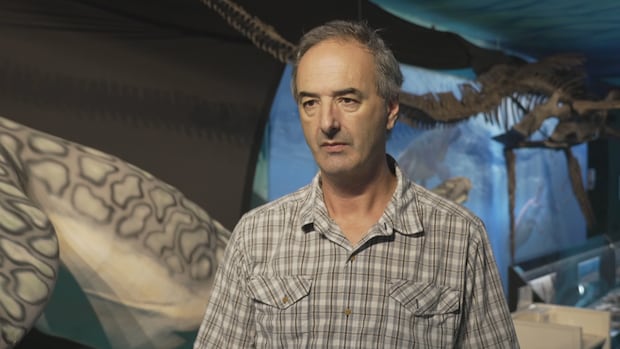
The Canadian Fossil Discovery Centre in Morden, Manitoba, has recently unveiled its latest exhibit featuring the Styxosaurus, a long-necked plesiosaur that roamed the seas during the Cretaceous period millions of years ago. The exhibit showcases reconstructions of this ancient marine reptile based on bones unearthed in 1983 at North Cox farm near Miami, Man. Using 3D printing technology, over 400 bones were replicated and assembled to create a life-sized skeleton of the Styxosaurus, a process that took several months to complete.
The Styxosaurus, which could grow up to 12 meters in length and weigh over 4,000 kilograms, had a distinctive long neck that made up half of its total length and featured between 60 to 72 vertebrae. Sporting a small eel-like head with sharp, cone-shaped teeth, this creature was a formidable predator in the ancient Western Interior Seaway that once covered the region where Manitoba now stands.
Visitors to the museum, like twelve-year-old Jorja Doerksen, have been captivated by the exhibit, with Doerksen expressing her fascination with the detailed skeletons and skin models on display. She noted her surprise at learning about the Styxosaurus, a creature she had not encountered before. The exhibit also invites visitors to suggest names for the Styxosaurus, a common practice among paleontologists, with the selected name to be announced at the end of the summer, offering the winner a Styxosaurus-themed prize. Doerksen shared her preference for the name “Apollo,” drawing inspiration from Greek mythology’s River Styx, after which the Styxosaurus is named.