
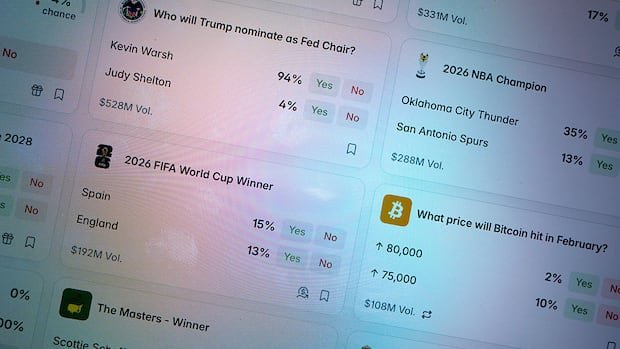
Investors eyeing opportunities in prediction markets entering the Canadian scene may face an uphill battle, according to recent findings. Platforms like Polymarket and Kalshi allow users to speculate on the likelihood of real-world events through buying and selling contracts, focusing on economic indicators, financial markets, and climate trends in Canada. Examples of current contracts on Polymarket include predictions on the Bank of Canada’s potential rate hike in 2026 and the possibility of 2026 marking the hottest month on record.
In contrast to traditional gambling setups, prediction markets lack a house for users to bet against. Instead, participants compete against each other, with the platforms generating revenue through nominal transaction fees per wager. A study by Yale University and London Business School researchers revealed that only a small fraction, approximately three percent, of Polymarket accounts, labeled as “skilled traders,” consistently generated profits and made accurate predictions. The study highlighted that losses from a larger group of traders directly funded the profits of the skilled minority.
With the imminent expansion of these markets in Canada through Wealthsimple’s collaboration with Kalshi, experts emphasize the importance for Canadians to comprehend their competition. Roberto Gómez-Cram, co-author of the study and an assistant professor at London Business School, advised that success in prediction markets requires sophistication and strategic decision-making rather than impulsive actions.
The research paper, based on data from Polymarket, encompassed $13.76 billion in trading volume across 1.72 million accounts, indicating that nearly 70 percent of the trading volume stemmed from less proficient traders. Consequently, the profits of successful traders were largely funded by the mistakes of the majority. The absence of a betting house necessitates a significant volume of trades for the system to operate effectively, with more trades translating to enhanced earnings for skilled traders.
Experts suggest that a combination of rapid news processing abilities, consistent trading experience, and advanced technical expertise such as computer programming characterizes top traders. These traders employ algorithms not only for trading but also for news analysis and predictive modeling. The authors accentuate the importance of informed decision-making, continuous learning, and a systematic approach to trading for aspiring skilled traders.
The surge in popularity of prediction markets, evident from the exponential rise in trading volume from $100 million in 2024 to $24 billion in 2026, has attracted the attention of financial firms seeking skilled traders. Hedge fund Tyr Capital, based in Florida, is among the firms actively recruiting prediction market traders with backgrounds in finance and economics. These traders are expected to apply analytical skills akin to traditional financial markets rather than relying on gambling instincts.
Concerns exist among experts regarding the misconception that prediction markets offer easy money-making opportunities. Luis Seco, a professor at the University of Toronto, views prediction markets more as entertainment than a viable income source for individuals. He cautions against underestimating the expertise and resources deployed by hedge funds in these markets, emphasizing the dominance of major players and the challenges faced by retail investors.
In essence, the allure of winning big in prediction markets may be overshadowed by the intricate dynamics and competitive landscape, urging caution and a thorough understanding of the market for potential participants.