
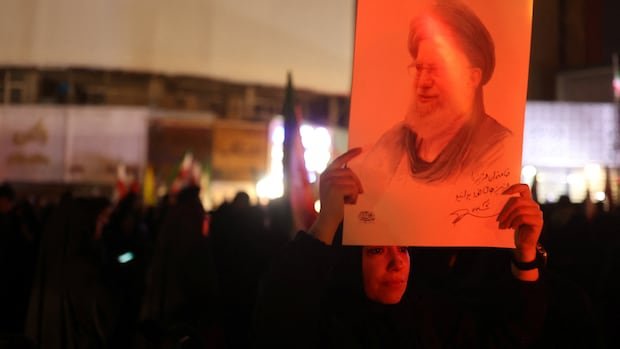
In the aftermath of the unexpected demise of Iran’s supreme leader in an operation involving the U.S. and Israel over the weekend, there has been widespread speculation and uncertainty surrounding the leadership succession and the current governing body. This marks only the second instance since the 1979 Islamic Revolution that a new supreme leader is being sought.
Ayatollah Ali Khamenei, who had led Iran for 37 years, passed away on Saturday without a designated successor. While there have been reports suggesting that Khamenei’s son, Mojtaba, is being considered as a potential successor, no official confirmation has been provided. However, the prospect of appointing the son of the deceased leader might not align with the intentions of the U.S., which seeks a change in regime.
Following the supreme leader’s death, temporary authority has been vested in a trio composed of the current president, the judiciary head, and a senior cleric from the Guardian Council. Presently, Iranian President Masoud Pezeshkian, judiciary chief Gholam-Hossein Mohseni Eje’i, and senior Shia cleric Ayatollah Ali Reza Arafi are overseeing the leadership transition. Iran’s Foreign Minister Abbas Araghchi has indicated that a new supreme leader will be selected within the week.
The process of appointing a new supreme leader typically involves the Assembly of Experts, comprising 88 Shia clerics whose candidacies are approved by the Guardian Council. However, due to the ongoing hostilities faced by Iran, the exact mechanisms for this decision remain uncertain. Recent reports from the Israel Defense Forces (IDF) highlighted an attack on the Assembly of Experts’ meeting place, raising concerns about the fate of the clerics attending the session.
Several potential successors have emerged, including Mojtaba Khamenei, who has close ties to Iran’s Islamic Revolutionary Guard Corps (IRGC) but lacks official governmental experience. Ali Reza Arafi, a senior Shia cleric endorsed by Khamenei, and Hassan Khomeini, the grandson of the Islamic Republic’s founder, are also being considered. Additionally, Reza Pahlavi, the exiled son of Iran’s last shah, has garnered attention as a potential successor, advocating for a transitional leadership role.
President Trump has shared his perspectives on the succession process, urging the Iranian populace to seize control of their government. While acknowledging the presence of suitable candidates to replace Khamenei, Trump refrained from naming specific individuals. The evolving situation in Iran has raised uncertainties regarding the country’s political future, with various scenarios such as a shift to democracy, military dictatorship, or potential regime collapse being contemplated.
As Iran navigates through this critical juncture, the path to a stable and democratic governance structure remains uncertain amidst external pressures and internal dynamics.