
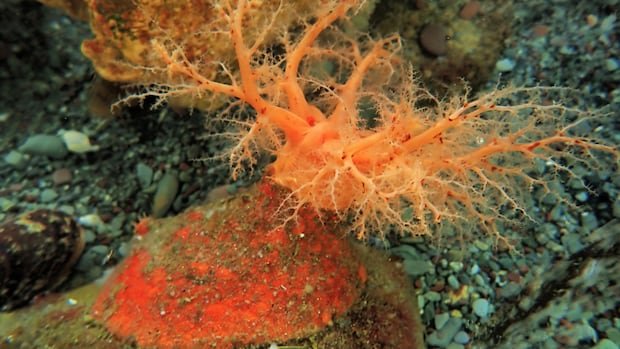
A recent study led by Sara Jobson, a doctoral student at Memorial University in Newfoundland and Labrador, has revealed a fascinating phenomenon involving scarlet sea cucumbers. The research showcased the remarkable ability of severed bits of flesh from these sea creatures to persist in a state that blurs the line between life and death.
The team, led by Jobson, coined the term “zombie tissue” to describe the peculiar behavior observed in the scarlet sea cucumber samples. Unlike typical animal tissue, which would deteriorate after amputation, the sea cucumber flesh displayed a unique ability to survive independently.
Published in Science Advances, the study documented how the amputated segments of the sea cucumber initiated a self-healing process when placed in seawater. The tissue sterilized the amputation site, sealed the wound, and gradually transformed into round, translucent structures with a red pigment core over several years.
Despite exhibiting characteristics of living organisms such as nutrient absorption and immune system activity, the regenerated tissue did not reproduce like traditional living entities. Jobson remarked on the enigmatic nature of these “zombie” samples, questioning their significance in the evolutionary context of sea cucumbers.
The implications of this discovery extend beyond the scientific realm, as Jobson highlighted the potential for further research opportunities facilitated by the resilient nature of the sea cucumber tissue. The study’s success was attributed in part to the culture of curiosity-driven exploration fostered by the research lab led by Annie Mercier, a professor of ocean sciences at Memorial University.
As Jobson continues to delve into the mysteries of these resilient tissue samples, the study opens up new avenues for exploration and underscores the importance of nurturing unconventional scientific inquiries.
For more information, visit the source link.