
Thermal drones paired with emerging artificial intelligence systems are proving effective in bolstering Alberta’s defenses against invasive and destructive wild boar.
Hannah McKenzie, the Alberta government wild boar specialist involved in the Wild Boar at Large Detection Project, highlighted the use of drones as part of a multifaceted approach to tackle the wild boar issue.
A recent report outlined a partnership between Alberta Agriculture and the University of Calgary to assess a novel aerial surveillance method for tracking wild boar, which pose a growing threat to agriculture and ecosystems in the Prairies.
The report, released in late March on the Alberta government website, emphasized the use of automated drones with infrared cameras as an innovative and non-intrusive alternative to conventional detection techniques.
In the spring of 2024, researchers deployed thermal drones equipped with heat radiation sensors to detect wild boar bodies. The drones operated best at night, capturing distinct heat signatures against the cooler surroundings.
The team then trained artificial intelligence programs to analyze the drone footage, identify wild boar accurately, and document the number of sightings, enhancing monitoring efficiency for this elusive species.
Traditional tracking methods such as ground tracking and helicopter surveys often fall short due to the nocturnal and cautious nature of wild boar. The aerial view provided by drones has proven invaluable in overcoming these challenges.
Ryan Brook, lead researcher for the Canadian Wild Pig Research Project at the University of Saskatchewan, praised the effectiveness of thermal drones in combating wild boar infestations in Canada and the United States.
The use of thermal drones allows for the observation of wild boar groups, known as sounders, across vast landscapes without disturbing them, shedding light on their destructive behavior.
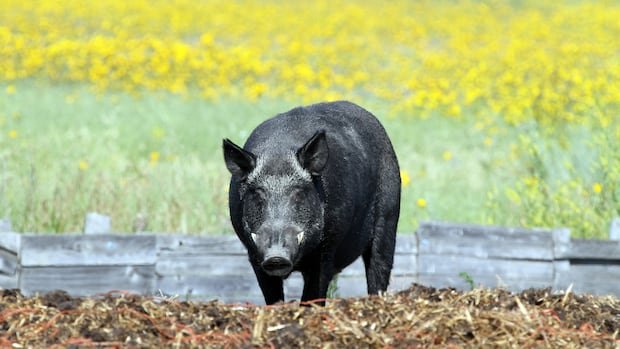
Wild boars in Alberta consist of hybrids of Eurasian wild boar and domestic pigs, causing significant ecological damage. These hybrids, sometimes referred to as “super pigs,” are highly destructive omnivores, posing a threat to agriculture and natural habitats.
Efforts to eradicate wild boar in Alberta have been reactive, but current initiatives focus on monitoring, trapping, strict regulations on wild boar farms, and a ban on sport hunting to curb their population growth.
The drone project marks a shift towards proactive measures, aiming to train AI programs to detect wild boar effectively, establish a standardized sighting database, and predict feral herd locations in Alberta through digital habitat mapping.
Two Alberta boar operations served as testing grounds for the project, covering over 3,000 kilometers with thermal drones and validating AI models using data from these farms. The project also involved tracking a wild sow with a GPS collar for movement data collection.
Despite promising results, challenges persist, such as the difficulty in detecting small piglets and distinguishing wild boar from other wildlife. Future research aims to enhance the AI programs’ accuracy in identifying wild boar across diverse landscapes.
The project also developed a habitat suitability map to predict wild boar presence in Alberta by integrating public sightings and habitat data, assisting in targeted mitigation efforts.
This collaborative, long-term monitoring program underscores the importance of ongoing efforts to combat wild boar infestations in Alberta, with a recognition that eradication will require a science-based national strategy.