
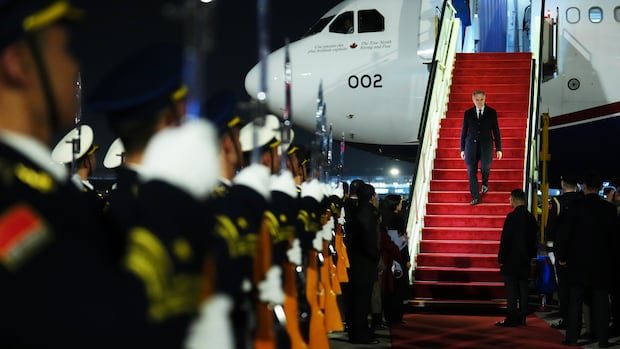
Prime Minister Mark Carney has arrived in Beijing, marking the initial visit by a Canadian prime minister to China in the past eight years. During his stay, Carney is scheduled to hold meetings with senior communist leaders before engaging with President Xi Jinping and attending a business banquet on Friday.
This visit follows the detainment of two Canadians by China for almost three years in 2019 as a response to the apprehension of a Chinese tech executive in Vancouver based on a U.S. extradition warrant. Carney aims to bolster trade relations and environmental collaboration with China while safeguarding sensitive sectors related to national security and the Arctic.
One of the key focal points of discussion will be China’s significant tariffs on products such as pork, canola, and seafood, which were implemented after Ottawa imposed tariffs on Chinese electric vehicles, steel, and aluminum. Leaders from Western and Atlantic provinces are advocating for the removal of these tariffs, with Saskatchewan Premier Scott Moe also present in China alongside Carney. However, Ontario Premier Doug Ford has expressed concerns about potential policy changes that could impact the Canadian auto industry.
Industry experts view this visit as brief yet crucial, as both China and Canada seek to move past previous diplomatic strains. Ottawa is striving to double its non-U.S. trade by 2035. Recent years have seen alerts about Chinese interference in Canadian elections, human rights issues concerning the Uyghur minority, freedom of speech in Hong Kong, and China’s military activities expanding beyond authorized maritime boundaries.
In response to these challenges, the Liberals labeled China a “disruptive global power” in 2022, citing differing values. Carney’s administration now regards Beijing as a strategic ally and recently advised two Liberal MPs to conclude a Taiwan trip early to avoid conflicting with the government’s stance of not recognizing Taiwan as an independent nation.