
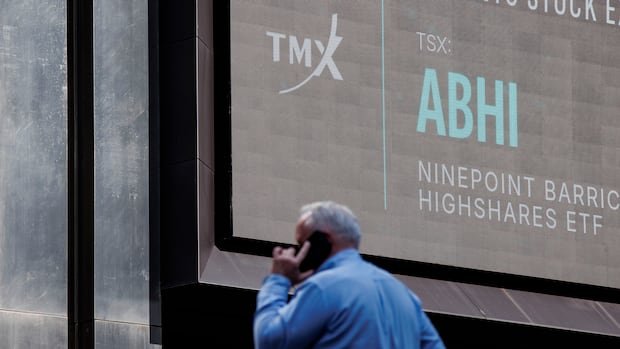
Canadian and U.S. stock markets experienced a decline on Friday due to concerns surrounding the impact of the U.S.-Iran conflict on interest rates. Dustin Reid, the vice-president and chief strategist for fixed income at Mackenzie Investments, noted that markets were exhibiting risk-off behavior in response to increased energy prices and inflation risks. This shift has led to market expectations of potential central bank interest rate hikes, affecting various asset classes, including equities.
The S&P/TSX composite index dropped by 537.57 points to 31,317.41, while in New York, the Dow Jones industrial average fell by 443.96 points to 45,577.47. Additionally, the S&P 500 index decreased by 100.01 points to 6,506.48, and the Nasdaq composite saw a decline of 443.08 points to 21,647.61.
Worries have escalated to the extent that traders have largely abandoned their bets on the possibility of the U.S. Federal Reserve cutting interest rates this year. Some are even considering the potential for rate hikes in 2026, a scenario previously deemed improbable before the onset of the conflict.
Lower interest rates could provide a boost to the economy and investment prices, a development that U.S. President Donald Trump has been advocating for. Prior to the conflict, traders were heavily speculating that the Fed would implement rate cuts at least twice in the current year. However, the risk of exacerbating inflation looms with lower rates, and investors perceive limited room for global central banks to reduce rates further to support their economies.
The May crude oil contract saw an increase of $2.68 USD, reaching $98.23 USD per barrel. The price of Brent crude has experienced significant fluctuations, surging from around $70 USD per barrel prior to the conflict to as high as $119.50 USD this week. These sharp swings reflect the uncertainty in financial markets as they assess the duration of the conflict and its potential impact on oil and gas production in the Persian Gulf.
Despite the market downturn, Reid expressed optimism regarding the Canadian dollar’s performance, stating that it has fared well in recent weeks, closely tracking the U.S. dollar amid substantial safe-haven flows. Stock markets historically have shown resilience following past conflicts, rebounding swiftly as long as oil prices do not remain elevated for an extended period. In the Canadian stock market, most sectors experienced negative trends, with basic materials exerting the most significant influence, while consumer non-cyclicals emerged as the only sector in positive territory.
The Canadian dollar was trading at 72.90 cents USD compared to 72.84 cents USD on the previous day. This stability in the Canadian dollar’s value reflects its relative strength amidst the prevailing market conditions.